
Don’t Wait for Next Wednesday to Rebuild the Crown Jewel
Sources checked . Incident guidance can change; follow the linked vendor advisories.
The compromise may already be underway. Build the fallback before you need proof that something is wrong.

In this article (5 sections)
Maybe the compromise started last week and your team hasn’t seen it yet. Maybe it starts next Wednesday. If I’m leading the cloud and security teams, I’m not waiting to find out which one it is before I give the business a second way to operate.
Here’s the exercise I’d run while production is still working. It’s Wednesday morning. You can’t vouch for corporate sign-in, the build pipeline, or the images in the registry. Someone suggests failing over to the second region. What does that region trust that the first one didn’t? If the answer is “nothing,” the exercise has already found a problem worth fixing.
Keep patching and investigating suspicious activity. In parallel, give a separate team a mandate now: build and rehearse a way to deliver the one thing the business cannot afford to lose. A quiet dashboard is time to do that work, not proof you can put it off.
Pick a promise, not a platform
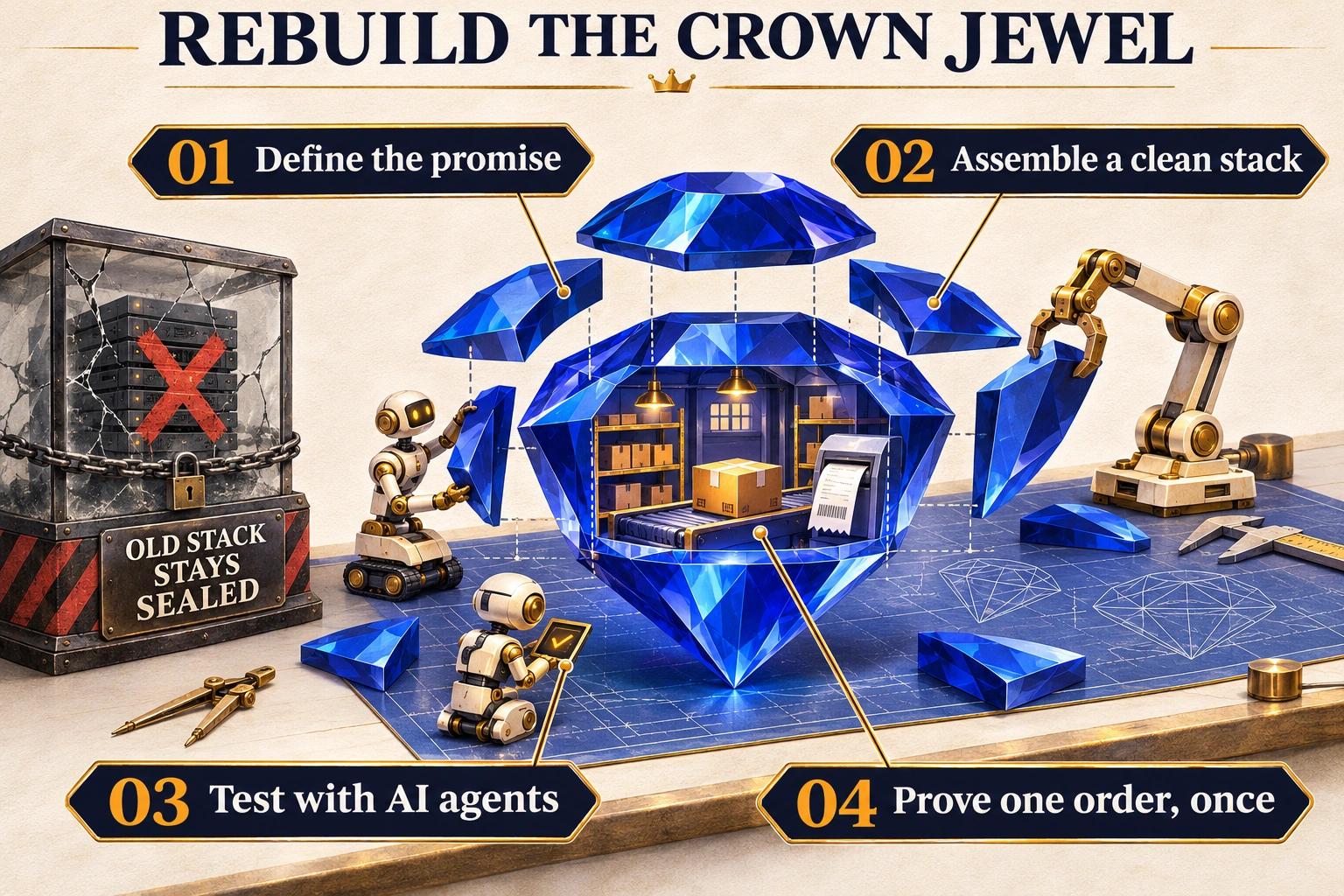
Imagine a distributor. Its crown jewel sounds like “the order platform,” until you ask a warehouse manager. For them, it’s a promise: We can take your order, reserve what’s in stock, and ship it exactly once. A temporary order screen and a manual handoff might keep that promise. A fully restored cluster that ships the same order twice won’t.
Give the operations lead a marker and have them draw that workflow. Circle the records you need to trust. Cross out every dependency that can wait. Then agree on what counts as enough to reopen: how long customers can wait, how many orders you need to handle per hour, and how you’ll account for orders that arrived after your last verified backup. Make those decisions in the tabletop. Use a separate drill to prove them.
Assemble a smaller business in a clean room
I’d budget for two ways to get the crown jewel running. A database backup preserves records. It doesn’t give the warehouse a way to accept the next order.
Path A: Keep a standby app
Build or buy a small application that can take an order, reserve stock, and hand it to the warehouse. Exercise it regularly in a separate environment. The test is whether you can start and use it when corporate sign-in, the usual build pipeline, the software registry, and the primary vendor are off limits. If the standby needs the same systems you’ve ruled out, it’s not your fallback.
Path B: Write a limited replacement in the clean room
If the primary and standby are both affected, start from the business rules and test cases you kept separately, not the old code or images. For the distributor, that might mean one order screen, a small ledger that rejects duplicates, and a warehouse handoff a person can check. Leave billing, dashboards, and other extras out of this first version. AI can help draft the app and tests in isolation, but use a verified toolchain, have engineers review the changes, and prove the workflow on synthetic data before it handles a real order.
Both paths need separate sign-in and deployment access, and only data you can reconcile against independent records. Keep the old environment isolated and preserve its evidence. If you can’t establish trusted access, tooling, or data yet, use a rehearsed manual process where it’s safe. If you can’t tell what already shipped, hold fulfillment rather than guess.
This is where I’d borrow from Kubernetes’ controller model: describe what should exist, then build toward that description from known inputs. For a recovery application, that means defining its components, permissions, data contracts, and fallback ahead of time. A failed component should be replaceable without dragging its neighbors down with it. You don’t need Kubernetes to work this way.
I wouldn’t put an abandoned open-source package, an opaque vendor build, or a service you can’t export data from on that critical path. Ask the same questions of every supplier: Can we verify what we’re deploying? Who is accountable for it? Can we replace it without losing the business records? If nobody can answer, leave it out of the recovery design.
Give the swarm work, not authority
Put a small team of agents to work in the isolated drill. One turns the order workflow into acceptance cases. Another drafts adapters or tests against synthetic records. A third flags missing evidence. Keep their workspace separate from production; they don’t get live credentials, approve their own changes, or reconnect the recovery environment. Two agents agreeing is still not independent evidence.
The new software should give both people and agents the same narrow, auditable actions to work with. If the model is unavailable halfway through the drill, a person should still be able to accept an order and verify its status. Try it with the model switched off. That’s the kind of AI-first design I want to see: useful when it’s present, survivable when it’s not.
Make the warehouse the judge
Send one synthetic order, then send the exact same request again. Find exactly one reservation and one warehouse receipt. Check the order ID, quantity, and status against the independent record. Stop the clock only when those checks agree. Then run long enough to see whether the workflow can keep up with demand. One verified transaction proves the path exists; it doesn’t prove you can clear Monday’s backlog.
That is the evidence I’d bring back to leadership: how long the first verified order took, what still needed a person, and which old dependency nearly stopped the rebuild. Have the business owner sign off before real traffic returns. NIST’s recovery guidance is a useful starting point for planning and exercising the recovery; the order test is how I’d make that discussion concrete.
Put the drill on the calendar now
This week, name the customer promise, give it a business owner, and write down which dependencies the recovery team is not allowed to use. Keep the workflow rules, test cases, and recovery materials outside that shared trust boundary, and verify them before the drill. Then set a date to run both scenarios in isolation: first with the standby app available, then with the primary and standby both off limits. Rehearse while production is healthy, not on live customer orders. Repeat the drill after a major change to identity, software delivery, or data.
At HackWednesday, we’ve looked at how agents can help a defender verify a patch. This is the same demand for evidence applied to continuity. At your next leadership meeting, ask: “If we found out on Wednesday that we’d been compromised since Monday, which customer promise could we still keep, and what evidence would we show?”
Follow the Wednesday Brief for more practical AI security ideas to try with your team.
Source notes
Follow these links to check the reporting and documentation behind this article.