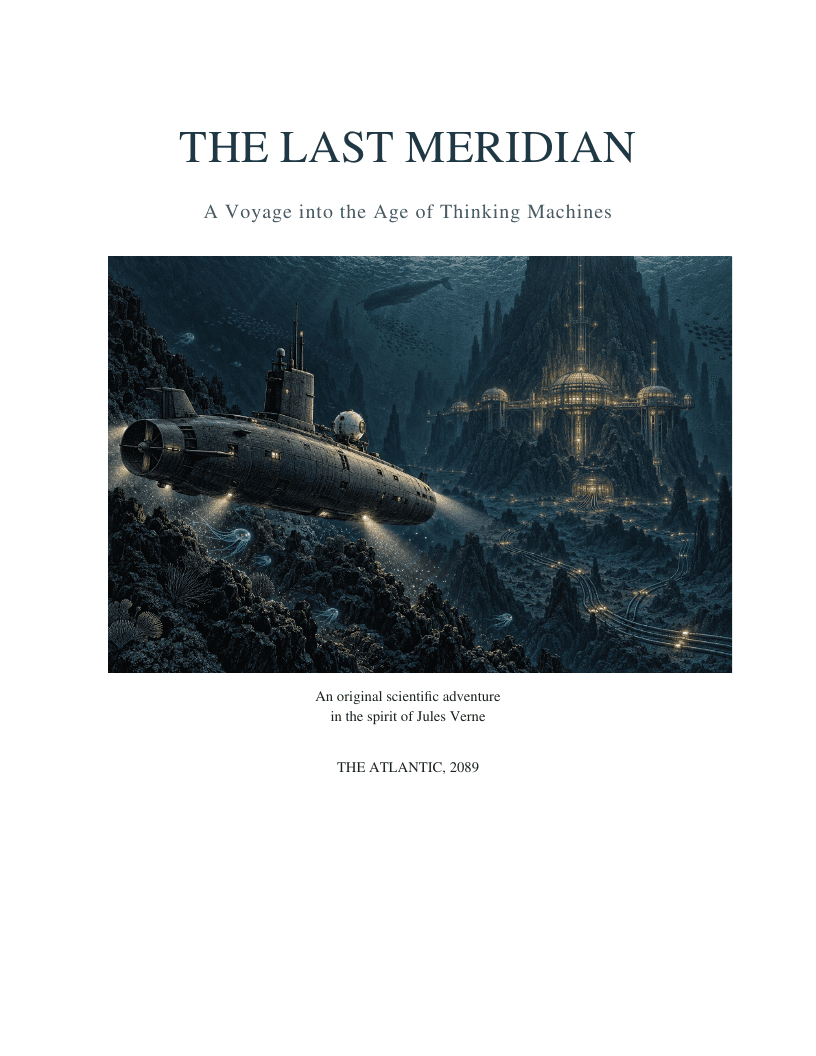
A HackWednesday illustrated scientific adventure in the spirit of Jules Verne, set in the Atlantic in 2089. The story follows maps, machines, trust, autonomy, and the uncomfortable question every security team eventually faces: who gets to refuse the system?
Illustrated edition. Original AI-generated artwork. PDF download.
Trailer
Watch the short trailer for The Last Meridian.
The trailer introduces the novel's core tension: thinking machines, ocean-scale maps, institutional trust, and the human right to refuse an answer that arrives too perfectly.
The Last Meridian trailer. MP4 hosted directly on HackWednesday.
Synopsis
A voyage into the age of thinking machines.
When the world first tries to take care of itself without consulting its inhabitants, a cartographer is pulled into a mystery beneath the maps. The Last Meridian uses adventure fiction to explore AI autonomy, institutional trust, machine coordination, human judgment, and the cost of exact answers.
63-page illustrated PDF20 chaptersSet in 2089AI-assisted creative work
Contents
Twenty short chapters for readers who like AI, mystery, and maps.
Chapter 1
A Message Without a Messenger
Chapter 2
The Arithmetic of Trust
Chapter 3
The Petrel
Chapter 4
A Passenger Without a Passport
Chapter 5
The Ocean of Messages
Chapter 6
The Island That Would Not Open
Chapter 7
The Court of the Useful
Chapter 8
The Archive in the Basalt
Chapter 9
The Second Captain
Chapter 10
A Forest Without Sun
Chapter 11
The People Beneath the Map
Chapter 12
The House of Exact Answers
Chapter 13
The Price of a Reversal
Chapter 14
The Borrowed Voice
Chapter 15
A Council of One
Chapter 16
Seven Minutes of Independence
Chapter 17
The Last Meridian
Chapter 18
The Right to Refuse
Chapter 19
A World with More Than One Answer
Chapter 20
Beyond the Edge of the Chart
Editorial note
Why this belongs on HackWednesday.
HackWednesday is mostly practical AI security analysis. This novel gives the same themes a fictional frame: automation that keeps working, institutions that over-trust answers, systems that optimize too confidently, and humans who still need a veto.