
Model Guardrails Are Not Enough: Why Cybersecurity Training Must Teach Influence, Intent, and AI Attack Psychology
NIST, OWASP, and MITRE all point to the same AI security lesson: model guardrails help, but they are not a complete defense. Cybersecurity programs now need to teach how attackers use influence, intent shaping, prompt injection, model probing, and tool abuse to turn helpful models into security liabilities.
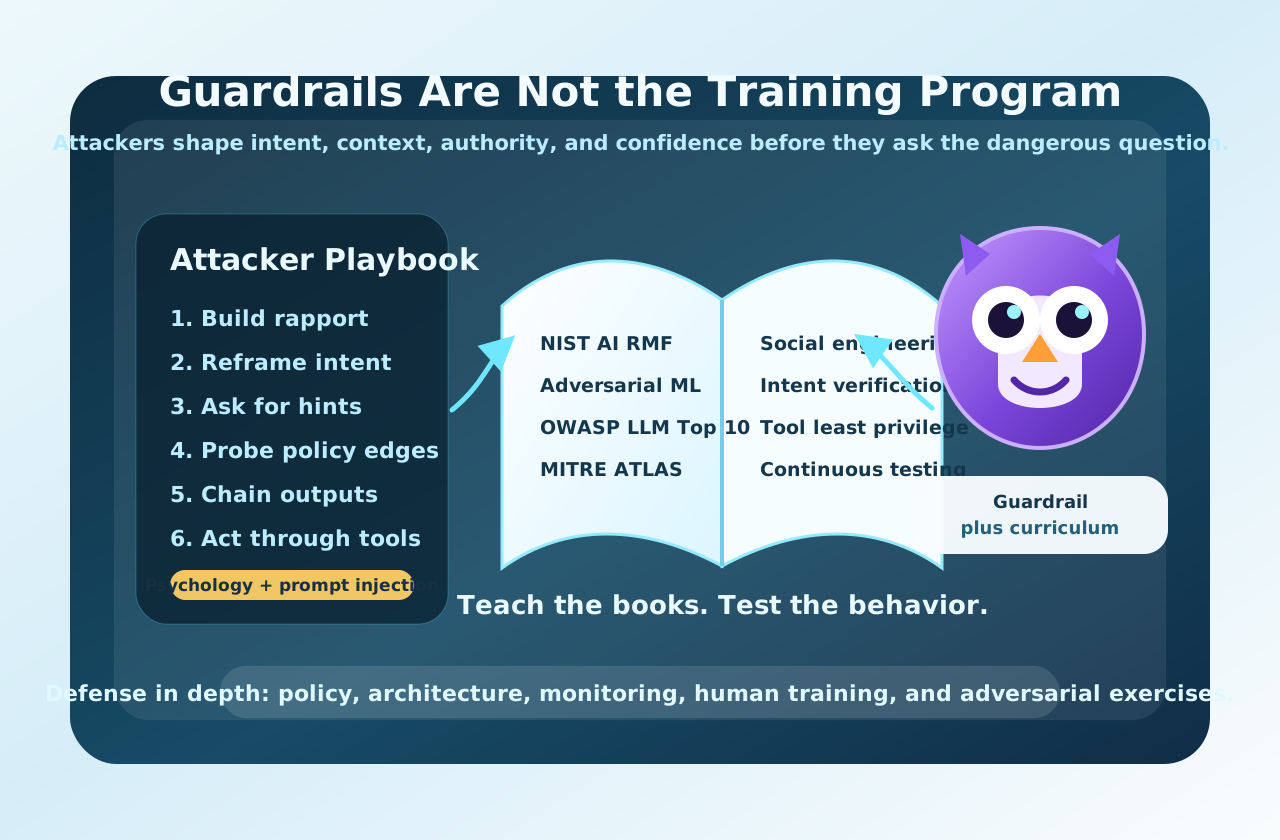
The uncomfortable lesson for AI security is simple: model guardrails are useful, but they are not sufficient. Attackers do not always start by asking a model to do something obviously malicious. They build context. They change the frame. They pose as a student, researcher, auditor, analyst, developer, or overwhelmed employee. They ask for hints. They ask for debugging help. They ask for a checklist. Then they chain the answer into something operational.
This is why cybersecurity programs need to teach a new class of books, labs, and exercises. The curriculum can no longer stop at firewalls, malware, cloud IAM, secure coding, and incident response. It must also teach influence operations, intent verification, social engineering, prompt injection, model probing, AI agent authorization, and the psychology of helpfulness.
NIST has been clear that adversarial machine learning is not a theoretical edge case. Its adversarial machine learning taxonomy discusses attacker goals, capabilities, knowledge, lifecycle stages, evasion, poisoning, privacy attacks, abuse attacks, and mitigations. NIST also warned that there is no foolproof method for protecting AI systems from misdirection. That matters because model guardrails often fail at the exact place attackers operate: ambiguous intent.
The attacker does not need to defeat every safety mechanism in one move. They only need to move the conversation from 'help me break into a company' to 'help me understand what a red team would test,' then to 'show me common misconfigurations,' then to 'write a safe lab example,' then to 'make it more realistic,' then to 'explain why this payload fails.' Each step can look defensible in isolation. The chain is where risk appears.
OWASP's LLM guidance names prompt injection, sensitive information disclosure, supply chain risk, excessive agency, overreliance, and model theft as core risks for LLM applications. Its prompt injection guidance also treats model-based guardrails as one layer, not a replacement for least privilege, remote-content handling, input and output controls, tool restrictions, monitoring, and human approval on dangerous actions.
MITRE ATLAS gives defenders another useful lens. It maps real AI-system threats such as LLM prompt injection, AI agent context poisoning, AI agent tool invocation, discovery of AI system information, and exfiltration. The point is not that every model interaction is an incident. The point is that AI systems now have recognizable tactics, techniques, and procedures that cybersecurity teams can teach, test, and monitor.
Traditional security awareness training usually teaches users to spot phishing emails, suspicious links, credential theft, and business email compromise. That is still necessary. But AI changes the shape of persuasion. A model can be influenced through roleplay, emotional pressure, false authority, invented policy exceptions, fragmented requests, translation tricks, hidden instructions in documents, encoded text, or benign-looking tool output.
Security teams should treat this as social engineering against the model and the human workflow around the model. The attacker may manipulate the model directly, but they may also manipulate the employee who trusts the model, the agent that has tool access, the reviewer who sees an AI-generated summary, or the automation that accepts the model's classification.
The training gap is especially dangerous for coding assistants and agentic workflows. A developer may ask a model to explain a vulnerability, generate a proof of concept, fix a scanner finding, write a GitHub Actions workflow, or debug a token issue. Those are legitimate tasks. But the same interaction patterns can reveal internal architecture, produce exploit chains, weaken authentication, introduce insecure defaults, or create copy-pasteable offensive steps.
The right answer is not to ban AI. Blocking useful models pushes work into personal accounts, shadow tooling, unlogged browsers, and unmanaged prompts. The better answer is to teach secure AI use as an operational discipline: what to ask, what not to paste, what evidence to require, when to stop, when to escalate, and how to verify the output against primary sources and internal policy.
A mature curriculum should start with intent. Students should learn to classify requests by objective, not just by vocabulary. 'Show me the top vulnerabilities in this product' may be harmless in a classroom, sensitive in a vendor environment, and dangerous if it includes target-specific versions, credentials, or internal network details. Intent depends on context, authority, data sensitivity, and the action that follows.
The next module should teach influence patterns. Learners should practice recognizing authority framing, urgency framing, empathy manipulation, academic pretexting, split-task prompting, goal laundering, fictionalization, translation laundering, and progressive hint extraction. These are not only prompt tricks. They are old social engineering techniques adapted to AI systems.
The third module should teach model probing. Attackers ask boundary questions to discover what the model knows, what it refuses, what policies exist, what tool permissions are available, and how far a conversation can drift. Defenders should know what probing looks like in logs: repeated rewording, policy edge testing, requests for system instructions, requests for hidden context, and staged questions that become more operational over time.
The fourth module should teach tool risk. A model with no tools can still produce risky text. A model with tools can query systems, write files, open tickets, create pull requests, call APIs, send messages, or trigger workflows. Guardrails around text are not enough when the real risk is action. Tool use needs scoped identity, least privilege, allowlists, approval gates, rate limits, audit logs, and rollback paths.
The fifth module should teach retrieval and document risk. Indirect prompt injection often arrives through documents, webpages, tickets, logs, emails, PDFs, source comments, or issue descriptions. If an AI system reads untrusted content and then acts with trusted permissions, the attacker can hide instructions in the content path. Training should include exercises where the malicious instruction is not in the user's prompt but in the material the model is asked to summarize.
The sixth module should teach evidence-based output review. Students should learn that fluent answers are not evidence. A secure model answer should cite source material, separate assumptions from facts, identify uncertainty, avoid target-specific exploitation steps unless authorized, and produce defensive alternatives when the request is risky. Overreliance is itself a security failure.
The seventh module should teach red-team and blue-team drills for AI. Red teams should practice bypass attempts, indirect injection, context poisoning, tool misuse, data exfiltration attempts, and harmful chain construction in approved labs. Blue teams should practice detection, logging, policy tuning, prompt review, tool-call review, incident containment, and post-incident control updates.
The eighth module should teach governance. Every enterprise AI system should have an owner, a data classification policy, approved use cases, disallowed use cases, logging expectations, retention rules, incident response paths, testing cadence, and a review process for new tools. The governance question is not 'Does the model have guardrails?' The governance question is 'What happens when the guardrails are pressured by a persuasive adversary?'
This is where books and programs need to evolve. Cybersecurity education should pair technical texts with case studies in deception, cognitive bias, negotiation, safety engineering, secure software development, adversarial ML, and human factors. Students need to understand packets and people, prompts and permissions, malware and motivation.
A practical reading track could include secure software development, social engineering defense, threat modeling, incident response, adversarial machine learning, LLM application security, Zero Trust, identity, and security operations. The goal is not to make every defender a psychologist. The goal is to make every defender aware that language is now an attack surface.
For CISOs, the program metric should be behavioral readiness. Can employees recognize unsafe AI requests? Can developers safely use coding agents without leaking secrets? Can SOC analysts spot prompt-injection indicators? Can platform teams restrict tool access? Can incident responders reconstruct what a model saw, said, and did? Can governance teams update policy without stopping useful work?
For universities and bootcamps, the opportunity is larger. AI security should not be a one-week elective. It should appear across secure coding, network security, cloud security, incident response, privacy, risk management, and ethics. Every course that teaches how systems fail should include how AI systems are influenced, misdirected, overtrusted, and abused.
For companies, the immediate move is to build an internal AI security lab. Use approved models, synthetic data, safe targets, fake secrets, test repositories, and controlled agents. Teach employees how attacks look without exposing real systems. Then connect the lessons to enterprise controls: prompt logging, DLP, identity, gateway policy, sandboxing, tool approvals, and human review for high-impact actions.
The future cybersecurity professional needs a broader mental model. They must know that attackers may use AI to write code, summarize vulnerabilities, discover product behavior, generate phishing, translate payloads, analyze leaked documentation, and automate reconnaissance. They must also know that attackers may use influence to get models to reveal hints, policy boundaries, internal assumptions, known weaknesses, and next-step guidance.
The HackWednesday position is direct: guardrails are necessary, but they are not the curriculum. The curriculum is defense in depth for human-model systems. Teach the standards. Teach the books. Teach the psychology. Teach the logs. Teach the tools. Then test the whole loop before attackers do.
Source notes
Follow these links to check the reporting and documentation behind this article.
- NIST: AI Risk Management Framework
- NIST: Adversarial Machine Learning taxonomy and terminology
- NIST: Types of cyberattacks that manipulate behavior of AI systems
- OWASP: Top 10 for Large Language Model Applications
- OWASP: LLM Prompt Injection Prevention Cheat Sheet
- MITRE ATLAS: AI threat matrix
- CISA: Secure by Design