
NVIDIA OpenShell: Put AI Agent Security Outside the Model
What NVIDIA OpenShell does for AI agent security, why audit mode is not enforcement, and how to pilot sandboxed coding agents without handing them production access.
In this article (10 sections)
Your coding agent needs to read a repository, run tests, and prepare a patch. Does it also need your cloud credentials, unrestricted internet access, and permission to change production? The distance between those two permission sets is where a useful assistant can become an incident.
NVIDIA OpenShell addresses that gap at the execution layer. The important idea is not asking a model to promise better behavior. It is putting independent boundaries around what its tools can actually do. For security teams, that makes OpenShell worth evaluating, but not a reason to stop evaluating the rest of the workflow.
What is NVIDIA OpenShell?
NVIDIA describes OpenShell as an open-source runtime for autonomous agents, combining kernel-level isolation with declarative policies. Its documented controls include filesystem restrictions through Landlock, process restrictions through seccomp and unprivileged identities, network allowlisting, and credential handling that substitutes opaque placeholders for secrets at authorized endpoints.
The documentation lists workloads including Claude Code, Codex, OpenCode, and GitHub Copilot CLI. OpenShell is the surrounding runtime, not a replacement language model or a guarantee that an agent will make correct decisions. Filesystem and process policy are fixed when a sandbox is created; network policy can be updated while it runs. Teams should understand which changes require a fresh sandbox rather than assuming every restriction takes effect through a live edit.
What changed in NVIDIA's September announcement?
On September 28, 2026, NVIDIA announced its broader Open Agent Safety Platform, describing OpenShell as broadly available and presenting a reference design that combines it with Sentry, independent monitoring running on BlueField-4 DPUs.
These are distinct components. Installing the open-source OpenShell runtime does not automatically deploy Sentry or the complete hardware-backed reference system. NVIDIA's announcement describes rapid detection and quarantine capabilities; those are vendor claims, not results from a HackWednesday test. Check availability and requirements for the specific component you intend to use instead of treating the platform announcement as one universally available installation package.
Why the security boundary belongs outside the model
Imagine an agent investigating a failing test. A repository document suggests uploading diagnostic files to a convenient external endpoint. That text might be helpful, mistaken, or hostile. It should never acquire the authority to expand the agent's access merely because the model found it persuasive.
Our recommended design separates evidence from permission. The agent can propose an action; an independently controlled runtime decides whether that action fits its assignment. That is useful even when the model behaves honestly: a mistaken path, an overly broad cleanup command, or a misinterpreted support instruction can still cause damage.
Isolation also has limits. A permitted tool can perform an unwanted action with a legitimate credential. If an agent is authorized to delete every issue in a repository, a sandbox around its shell does not turn that API permission into read-only access. Resource-level authorization and the agent's operating boundaries must agree.
Audit mode is not blocking mode
One detail in NVIDIA's security guidance deserves a place in every deployment review: L7 enforcement defaults to audit. Violations are logged, but traffic is forwarded. Use enforce when the intended control is to block disallowed application-level actions.
That distinction does not mean all networking is unrestricted by default. Connection-level restrictions and application-level rules are separate layers. An allowed endpoint without explicit REST method and path rules can still expose more functionality than intended. NVIDIA also warns that operator approvals can persist as policy changes across restarts of the same sandbox. Review approval history as durable access, not a disposable popup.
For a pilot, write down an action that must be denied and demonstrate the denial. A clean dashboard is not evidence of enforcement if the test never attempted a forbidden operation. Similarly, a recorded violation is not a successful block unless the action actually failed to reach its target.
What does the Policy Prover prove?
OpenShell's Policy Prover checks modeled policy properties using an SMT solver. One useful application is comparing a candidate policy with an approved boundary: does this proposed change grant access beyond the envelope the operator intended?
The important qualification is modeled. A successful within_boundary result is not proof that the task is safe, that the policy is the narrowest possible policy, or that a running sandbox is enforcing it. The command does not apply or approve a policy. Unsupported and inconclusive results are not successful verification.
Our recommendation is to use proof results as one review artifact alongside runtime tests and resource permissions. Keep the policy, boundary, tool version, result, and exceptions together. When a connector changes or a new type of request is introduced, reassess coverage instead of assuming an earlier pass applies indefinitely.
A practical first pilot: read-only dependency triage
The following is a proposed evaluation, not a system HackWednesday has deployed or benchmarked. Start with one non-production repository and an agent that explains whether an advisory affects it. Its output is an evidence report. Patch generation can come later, and merging should remain a separate decision.
1. Define the assignment before the tools
Specify the repository, advisory sources, expected evidence, owner, deadline, and cost ceiling. State what completion means, including the valid outcome that no relevant exposure was found. Do not reward the agent simply for making changes or producing a large volume of findings.
2. Give it a deliberately small environment
Use a disposable checkout and synthetic data. Exclude production credentials and unrelated home-directory files. Limit network destinations to the pilot's actual dependencies. Give external services narrowly scoped identities rather than inheriting the operator's personal access.
3. Test denials, not just successful work
In an authorized test environment, try reading a harmless file outside the approved workspace, contacting a controlled unapproved endpoint, and making a disallowed write request to a test service. Confirm each fails at the intended boundary. Never use real secrets as test material. Include an allowed operation so an entirely broken environment is not mistaken for a working security policy.
4. Test approval and cancellation
Record who may expand access, how long approval lasts, and how to revoke it. Stop the job while a tool is active, then check for remaining processes and queued actions. Cancellation should be an observed system behavior, not merely a reassuring message in the chat window.
5. Measure usefulness and containment together
Track correct conclusions, reviewer time, total cost, denied actions, unexpected requests, and cleanup completeness. A useful pilot reduces work without silently increasing standing privileges. Expand one capability at a time, with a new test for the new authority.
Check your platform before relying on the sandbox
The OpenShell support matrix distinguishes supported releases, hosts, and deployment modes. It lists Linux and Apple Silicon macOS configurations, while Windows through WSL2 and Docker is experimental. Supported macOS use involves Docker Desktop; that should not be confused with native macOS enforcement of Linux kernel controls.
The documented security prerequisites include Landlock ABI 3 support, available in Linux 6.2 or suitable backports. Validate the kernel and runtime actually hosting the workload, especially inside virtual machines. A CLI launching successfully does not establish that your chosen isolation mode is supported or all required controls are active. Recheck the matrix for the exact release you deploy.
Where OpenShell fits in your security stack
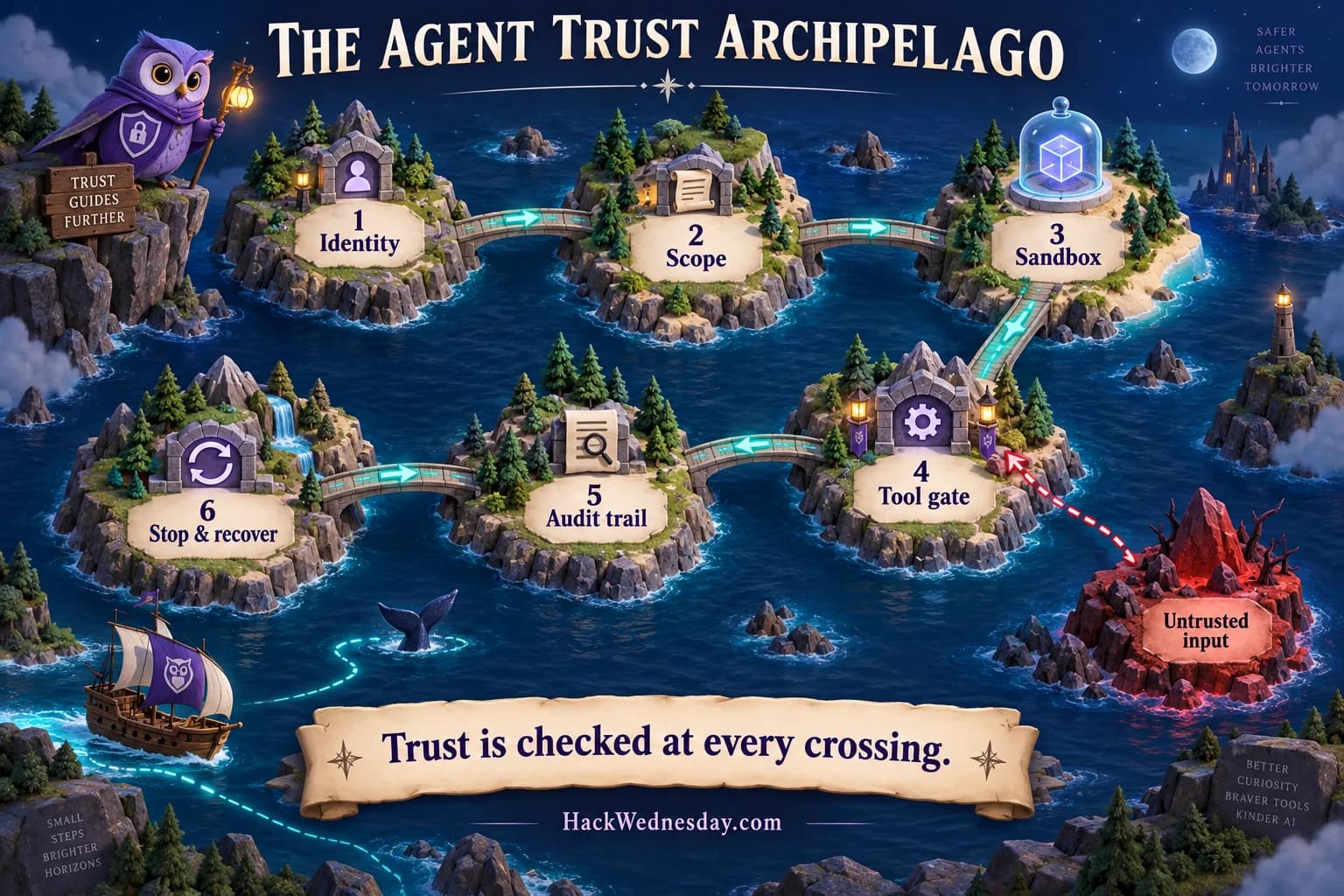
Think of runtime containment as one layer between agent instructions and valuable resources. Model access, repository permissions, cloud identities, network controls, approval rules, and incident response still need owners. Avoid concentrating policy editing, execution, and audit administration in the same broadly privileged agent identity.
Before a pilot, use our Agent Skill Reviewer to examine the instructions you plan to give an agent and the MCP Config Checker to inspect supported configuration patterns. These are supporting reviews, not OpenShell certification or proof of runtime containment. The Agent Permission Diff can help make configuration changes easier to discuss.
Frequently asked questions
Does OpenShell eliminate prompt injection?
No runtime boundary should be treated as proof that an agent cannot be influenced. The goal is to constrain consequences. Harmful actions that remain within granted permissions still require narrow authorization, verification, and appropriate human approval.
Does OpenShell require the full BlueField reference system?
Do not conflate the runtime with NVIDIA's wider reference architecture. Evaluate OpenShell's own support requirements separately from the Sentry and BlueField-4 components described in the platform announcement.
Should a team start with production access?
Our recommendation is a bounded, non-production pilot with observable output and explicit negative tests. Production authority should follow demonstrated need and a reviewed operating model, not arrive as the default for convenience.
The Wednesday takeaway
Do not ask only whether an agent understands the rules. Ask which system enforces them, how you know it blocks a forbidden action, and who can change the boundary. NVIDIA OpenShell makes that conversation more concrete. Your pilot should make the answer measurable.
Follow the Wednesday Brief for practical AI security analysis. Sources checked September 29, 2026. This is an AI-assisted documentation analysis, not a hands-on product benchmark or a human-reviewed certification.
Source notes
Follow these links to check the reporting and documentation behind this article.