
No One Knows What Goes Into GitHub Anymore: The New Shift Left Is Continuous Security Monitoring
PR reviews are no longer enough for modern GitHub security. Code, AI-generated changes, dependencies, secrets, CI logs, and runtime signals are growing too fast. The next shift-left model is continuous security monitoring across the full software path.
No one knows what goes into GitHub anymore. That is not an insult to developers or reviewers. It is a realistic description of modern software. A single pull request can include human-written code, AI-generated code, copied examples, transitive dependency changes, generated files, infrastructure configuration, workflow permissions, secrets handling, container behavior, and runtime assumptions that will not be visible from the diff alone.
The old shift-left story was useful: catch issues earlier, run scanners before production, and make security part of engineering instead of a late-stage audit. But the scale changed. Code volume is rising. Security logs are rising. Dependency graphs are deeper. CI/CD systems are more powerful. AI coding assistants can produce changes faster than reviewers can reason about them. The bottleneck is no longer whether a pull request was reviewed. The bottleneck is whether the review had enough evidence to be meaningful.
PR reviews are still necessary, but they are not sufficient. A human reviewer can understand intent, maintainability, ownership, architecture, and subtle business logic. But a reviewer cannot manually reconstruct every dependency risk, secret exposure path, infrastructure permission, CodeQL flow, container package, SaaS callback, and runtime telemetry trail for every change. When teams pretend that two approvals equal security, they create a comfortable ritual instead of a control.
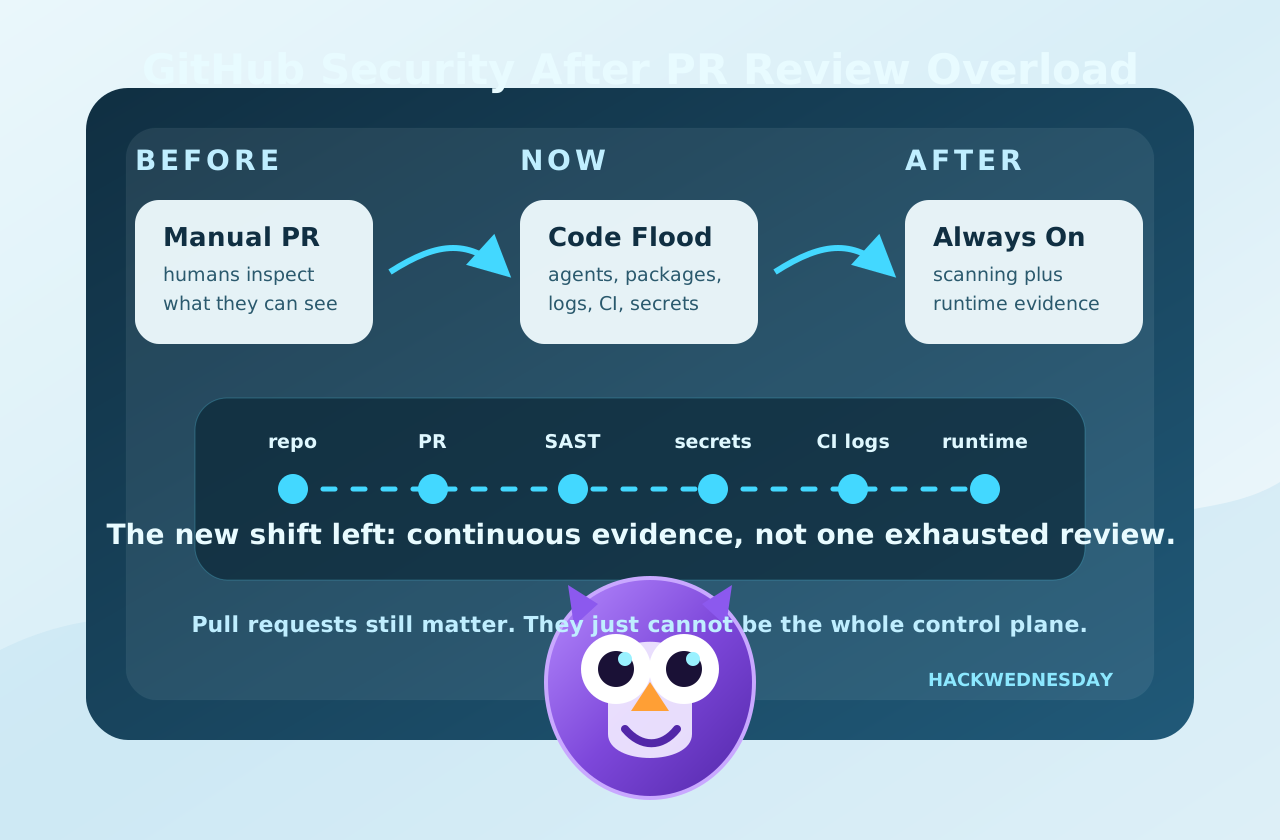
Before, security review often looked like a gate. A developer opened a pull request, a reviewer scanned the diff, CI ran tests, and security tools raised findings if they were configured. If the change looked reasonable and the checks were green, it merged. This worked better when repositories were smaller, release trains were slower, dependency graphs were simpler, and build systems did less on behalf of the organization.
Now, GitHub is not just source control. It is a developer identity surface, automation platform, package-supply-chain gateway, deployment coordinator, evidence store, and increasingly a place where AI agents operate. A GitHub change may alter cloud permissions, CI workflow behavior, dependency resolution, image contents, model prompts, MCP tools, deployment environments, and observability. The pull request is the visible tip of a much larger security object.
After, the new shift left has to become continuous security monitoring. This does not mean replacing developers with scanners. It means turning every change into a live evidence packet. The PR should show what changed, who or what produced it, which files and services are affected, which dependencies moved, whether secrets were introduced, whether dangerous workflow permissions changed, whether reachable code paths are exposed, and whether runtime signals after deployment match the expected behavior.
The practical model is shift left, shift right, and shift everywhere. Shift left still matters for secure design, threat modeling, dependency review, static analysis, secrets blocking, and infrastructure-as-code checks. Shift right matters for runtime detection, egress monitoring, identity behavior, production telemetry, and incident feedback. Shift everywhere means the same risk object follows the change from issue to branch, pull request, build, artifact, deployment, runtime, alert, and fix.
A better GitHub security workflow starts with risk-tiered reviews. Not every pull request deserves the same ceremony. Documentation changes, frontend copy, authentication changes, GitHub Actions changes, dependency bumps, Terraform changes, payment logic, model gateway changes, and production deployment code do not carry equal risk. Security teams should define risk labels automatically from paths, CODEOWNERS, dependency manifests, workflow files, secrets APIs, identity code, and internet-facing services.
The second control is machine-enforced context. Rulesets, branch protection, required reviews, required status checks, code scanning, dependency review, and secret scanning should create the baseline. Humans should spend their time on judgment, not remembering whether a repository is configured correctly. If a control is important enough to discuss in a security meeting, it is usually important enough to encode as policy.
The third control is PR evidence, not PR theater. A good security review should answer concrete questions: Did this change touch authentication, authorization, cryptography, deserialization, logging, input validation, egress, secrets, CI/CD, deployment, or privileged APIs? Did it add or update dependencies? Did it alter build scripts or GitHub Actions permissions? Did an AI tool produce any part of the change? Are generated files or vendored files hiding behavior that reviewers will skip?
The fourth control is continuous monitoring after merge. Security cannot stop when the button says merged. New deployments should be correlated with runtime behavior: new outbound domains, new cloud API calls, new secrets access, new error patterns, new admin actions, new package downloads, and new authentication flows. The goal is not to drown teams in logs. The goal is to preserve enough context so a suspicious signal can be tied back to the change that introduced it.
This is where log growth becomes a security architecture problem. Code scanning alerts, Dependabot alerts, secret scanning alerts, GitHub audit logs, CI logs, artifact metadata, cloud logs, EDR events, SIEM detections, and application traces all exist in different places. If security teams cannot join them by repository, service, owner, commit, workflow, package, identity, and deployment, they are not monitoring a system. They are searching through debris.
AI makes the problem sharper. AI-generated code can be useful, but it can also increase change volume, normalize unfamiliar patterns, and create reviewer fatigue. Agentic coding tools may run commands, edit multiple files, fetch dependencies, write tests, and propose fixes. Organizations need a record of which human, model, agent, prompt, tool, and environment contributed to a change. The future review question is not only 'Who approved this?' It is also 'What produced this, under what constraints, and what evidence did it leave?'
The answer is not to block AI coding or ban GitHub automation. That would slow defenders and push work into less visible channels. The better answer is sandboxed development, approved agent identities, scoped tokens, read-only defaults, egress controls, signed commits or trusted provenance where appropriate, and logs that connect agent activity to pull requests and deployments. Security teams should make the safe path faster than the unsafe path.
A modern shift-left program should have a minimum operating model: inventory every repository, assign owners, classify services by risk, define repository rulesets, require pull requests for protected branches, enable secret scanning and push protection, enable dependency review, run code scanning on pull requests, harden GitHub Actions, prefer OIDC over static cloud keys, generate SBOMs for important releases, and export security signals into a place where AppSec and SOC teams can see the same story.
For CISOs, the key metric is not the number of pull requests reviewed. Better metrics are security-control coverage, high-risk PR review latency, secret-block rate, dependency-risk time to decision, code-scanning fix time, protected-branch coverage, workflow-permission drift, percentage of production repositories with owners, and the percentage of alerts that can be mapped to a service and commit. These are operating metrics, not vanity dashboards.
For engineering leaders, the point is not to add friction. It is to reduce ambiguous friction. Developers should not wait three days for a security reviewer to rediscover what automation could have summarized in three seconds. A good system tells the developer why a change is high risk, what evidence is missing, which owner needs to review it, and what action will unblock it. Security becomes more useful when it is specific.
For AppSec teams, the new workflow is to design review packets. Each high-risk pull request should automatically include a compact summary: changed trust boundaries, changed dependencies, changed secrets behavior, changed workflows, scanner results, reachable services, related incidents, and recommended reviewer focus. AI can help create this packet, but the packet must cite evidence from tools rather than hallucinating confidence.
For SOC teams, the opportunity is to connect code to detection. When a risky change merges, the SOC should know what new behavior is expected. When runtime behavior deviates, the alert should point back to the commit, deployment, workflow, and owner. This is how organizations move from reactive alert handling to software-aware detection. The code path and the incident path should not be separate universes.
The phrase 'no one knows what goes into GitHub anymore' should become a design constraint. Assume the system is too large for manual review alone. Assume some code is AI-assisted. Assume logs will keep growing. Assume dependencies will keep changing. Then build a security workflow that turns every change into evidence, every evidence stream into context, and every context signal into faster decisions.
The future of shift left is not one more scanner in the PR. It is continuous security monitoring that starts before code is written and continues after code is running. Pull requests still matter. Human judgment still matters. But the winning teams will stop treating PR approval as the finish line. They will treat it as one checkpoint in a continuous loop: design, code, scan, review, build, deploy, monitor, learn, and feed the result back into the next Hack Wednesday.
Source notes
Follow these links to check the reporting and documentation behind this article.
- GitHub Docs: About pull request reviews
- GitHub Docs: About rulesets
- GitHub Docs: Available rules for rulesets
- GitHub Docs: Configuring default setup for code scanning
- GitHub Docs: Code scanning alerts
- GitHub Docs: Secret scanning detection scope
- GitHub Docs: Dependency review
- GitHub Docs: Security for GitHub Actions
- NIST SP 800-218: Secure Software Development Framework
- NIST NCCoE: Secure Software Development, Security, and Operations Practices
- CISA: Secure by Design