
Atlassian Review Incident Lessons: PRGB, Deployment Metadata, and the Future of Continuous Assurance
Atlassian's public security material shows the limits of peer review and green builds at modern scale. The lesson for security teams is not to abandon review, but to turn review into continuous assurance backed by metadata, scanning, provenance, logs, and post-incident learning.
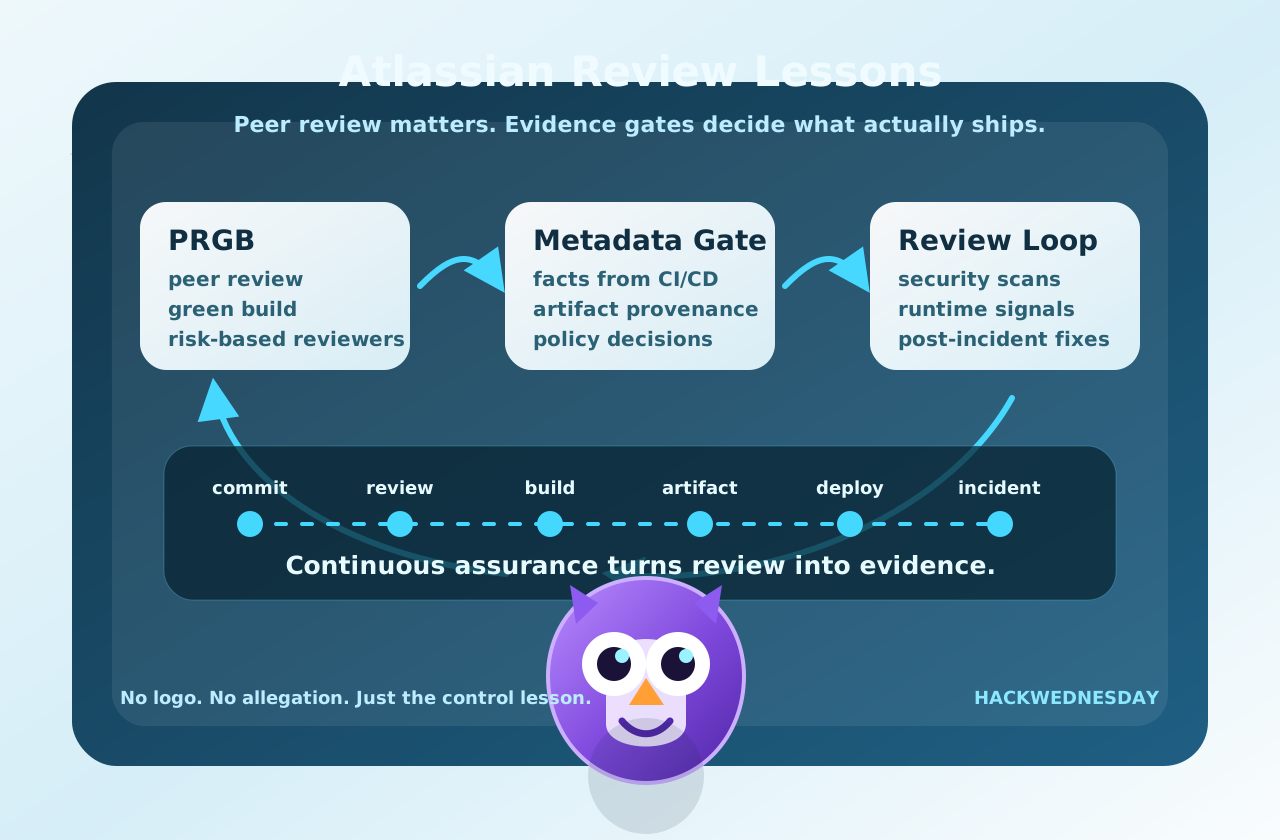
Important framing first: this article is not claiming that Atlassian suffered a new breach called the 'Atlassian review incident.' It is using Atlassian's public security documentation, deployment-control writing, security bulletins, and incident-review guidance as a practical case study for a bigger industry problem: peer review alone cannot carry modern software security.
Atlassian publicly describes a security model that includes peer review, green builds, threat modeling, static analysis, manual testing, bug bounty coverage, logging, monitoring, and post-incident review. That is exactly why the case study is useful. This is not a weak security program being held up as a straw man. It is a mature software organization showing, in public, how hard it is to scale trust across code, infrastructure, dependencies, builds, deployments, and incidents.
The phrase to focus on is Peer Review, Green Build, or PRGB. Atlassian describes PRGB as an open source style approach where changes are reviewed by one or more peers, reviewer count increases with criticality, and the green build requirement rejects changes that fail integration, functional, unit, or security tests. That is a strong baseline. It encodes a practical truth: software security needs both human review and machine checks.
But PRGB is also a useful boundary line. Peer review can catch intent mismatch, design errors, unsafe assumptions, and maintainability issues. Green builds can catch broken tests and known scanner findings. Neither automatically proves that the final artifact is trustworthy, that every handoff preserved the compliance state correctly, that dependencies are safe in context, or that runtime behavior stayed inside the expected boundary after deployment.
Atlassian's own deployment metadata work makes that point clearly. In a 2024 engineering post, Atlassian explained that prior production deployment controls were limited in scope and relied heavily on trust across the source, build, and deploy chain. The post called out implicit delegated trust, complexity, lack of transparency, errors, limited accountability, and scalability challenges as risks in that model.
That is the real review incident lesson. The incident may not be a single spectacular breach. The incident is architectural: organizations keep treating review as a moment, while the risk lives across a chain. A pull request can look approved. A build can look green. A package can look compliant. A deployment system can accept a label. But if every system simply trusts the previous system's assertion, the whole control plane becomes a relay race of assumptions.
The better model is evidence. Atlassian described a Deployment Metadata Platform where CI/CD metadata and attestations inform deployment policy decisions. That is the right direction for every security team. Instead of asking, 'Was there a review?' ask, 'Which review happened, for what change, under which risk tier, against which controls, producing which artifact, deployed by which mechanism, with what runtime evidence afterward?'
Modern software teams need this because the volume has changed. Code is growing. AI-generated code is growing. Third-party dependencies are growing. Security logs are growing. CI/CD systems are growing more powerful. Atlassian's July 2026 security bulletin, for example, listed dozens of high-severity vulnerabilities and critical third-party vulnerabilities across products, while noting that many reflected upstream open-source library activity and dependency scanning results. That is the environment every large software organization now lives in.
This is not an Atlassian-only issue. It is the normal condition of enterprise software. Reviewers cannot manually reason through every transitive dependency, build step, generated file, infrastructure permission, artifact promotion, token scope, runtime call path, and emergency patch. PR review remains necessary, but it is not enough. The control must become continuous.
Continuous assurance means the review does not end when the pull request merges. It starts at design and keeps moving through code, dependency changes, static analysis, secret scanning, build provenance, artifact signing, deployment gates, runtime telemetry, detection engineering, customer impact analysis, and post-incident review. The security object is not the pull request. The security object is the full change lifecycle.
For AppSec teams, the practical move is to turn PR review into a security evidence packet. Every high-risk change should show changed trust boundaries, changed dependencies, secrets behavior, workflow permission changes, scanner results, generated files, sensitive paths, owners, and deployment blast radius. AI can summarize this packet, but it must cite tool evidence rather than invent confidence.
For platform teams, the control is metadata and provenance. Build systems should emit attestations. Artifact stores should not be allowed to invent compliance. Deployment gates should query policy based on facts from source, build, artifact, and environment state. If the organization cannot trace from production artifact back to commit, review, test result, dependency set, and deployment identity, it does not have continuous assurance. It has hope with dashboards.
For SOC teams, the control is joining code and runtime. When a high-risk change deploys, detections should know what new behavior is expected. New outbound domains, new secrets access, new administrative calls, unusual package downloads, unusual CI behavior, and identity changes should be correlated back to repository, commit, workflow, service, and owner. That is how post-merge monitoring becomes software-aware instead of alert-only.
For incident response teams, Atlassian's public incident-management guidance is the second half of the lesson. Atlassian says incidents require detection and analysis, severity categorization, containment, eradication, recovery, notification where appropriate, and a post-incident review process. That structure matters because continuous assurance is not only a pre-production control. It is a learning system. Every incident should improve the next review, the next rule, the next test, and the next deployment gate.
The weakest security programs treat postmortems as documents. Better programs treat them as control updates. A good review asks what signal was missing, what evidence was ignored, what policy should have blocked the change, what test should exist, what detection should fire earlier, and what owner should be automatically notified next time. If those improvements do not land in code, configuration, monitoring, and training, the post-incident review is theater.
The next version of shift left should learn from this pattern. Shift left is not simply 'run a scanner in the pull request.' That was the first wave. The next wave is shift left plus shift right plus shift through the chain. Review before code. Scan during code. Prove during build. Gate during deploy. Observe during runtime. Learn after incidents. Feed the findings back into the next review.
Security leaders should measure this with operational metrics. Track protected-repository coverage, PRGB or review-rule coverage, high-risk pull-request latency, code-scanning fix time, secret-block rate, dependency-risk decision time, signed-artifact coverage, deployment-gate bypasses, workflow-permission drift, incident-to-control-update time, and percentage of production alerts that map cleanly to a service, owner, commit, and deployment.
AI will make the lesson more urgent. Agentic development tools can generate code, edit configuration, add packages, write workflows, run tests, and propose fixes faster than humans can read every line. Blocking AI is not a scalable answer. Letting AI operate without traceability is worse. The usable answer is controlled autonomy: sandboxed agents, scoped credentials, reviewable prompts, immutable logs, provenance, approval gates, and continuous monitoring.
Atlassian's public materials give security teams a useful vocabulary: peer review, green build, metadata gates, continuous assurance, centralized logging, vulnerability management, bug bounty, and post-incident review. HackWednesday's recommendation is to connect those ideas into one operating model. Do not ask whether review exists. Ask whether review produces evidence. Do not ask whether a build is green. Ask whether the artifact is provable. Do not ask whether the incident was documented. Ask whether the system became harder to compromise afterward.
The takeaway is simple: review is no longer a single step. It is a loop. PRGB is a strong starting point, but the future belongs to teams that attach facts to every software change and carry those facts all the way into production monitoring and incident learning. That is the new Hack Wednesday control plane: peer review where humans add judgment, metadata where machines add proof, and continuous assurance where the system keeps learning.
Source notes
Follow these links to check the reporting and documentation behind this article.
- Atlassian: Security Practices
- Atlassian: Security in Software Development
- Atlassian: Evolving deployment controls enforcement
- Atlassian: July 21, 2026 Security Bulletin
- Atlassian: Security Incident Management Process
- Atlassian: Creating postmortem reports
- NIST SP 800-218: Secure Software Development Framework
- CISA: Secure by Design