
Autonomous Agentic Security Platforms: Why Unplugging the Cable Is Not Enough
Security teams need autonomous, self-service agent platforms with live insight across SIEM, identity, endpoint, cloud, code, email, and network controls because AI-speed attacks will not wait for ticket queues or manual cable-pulling.
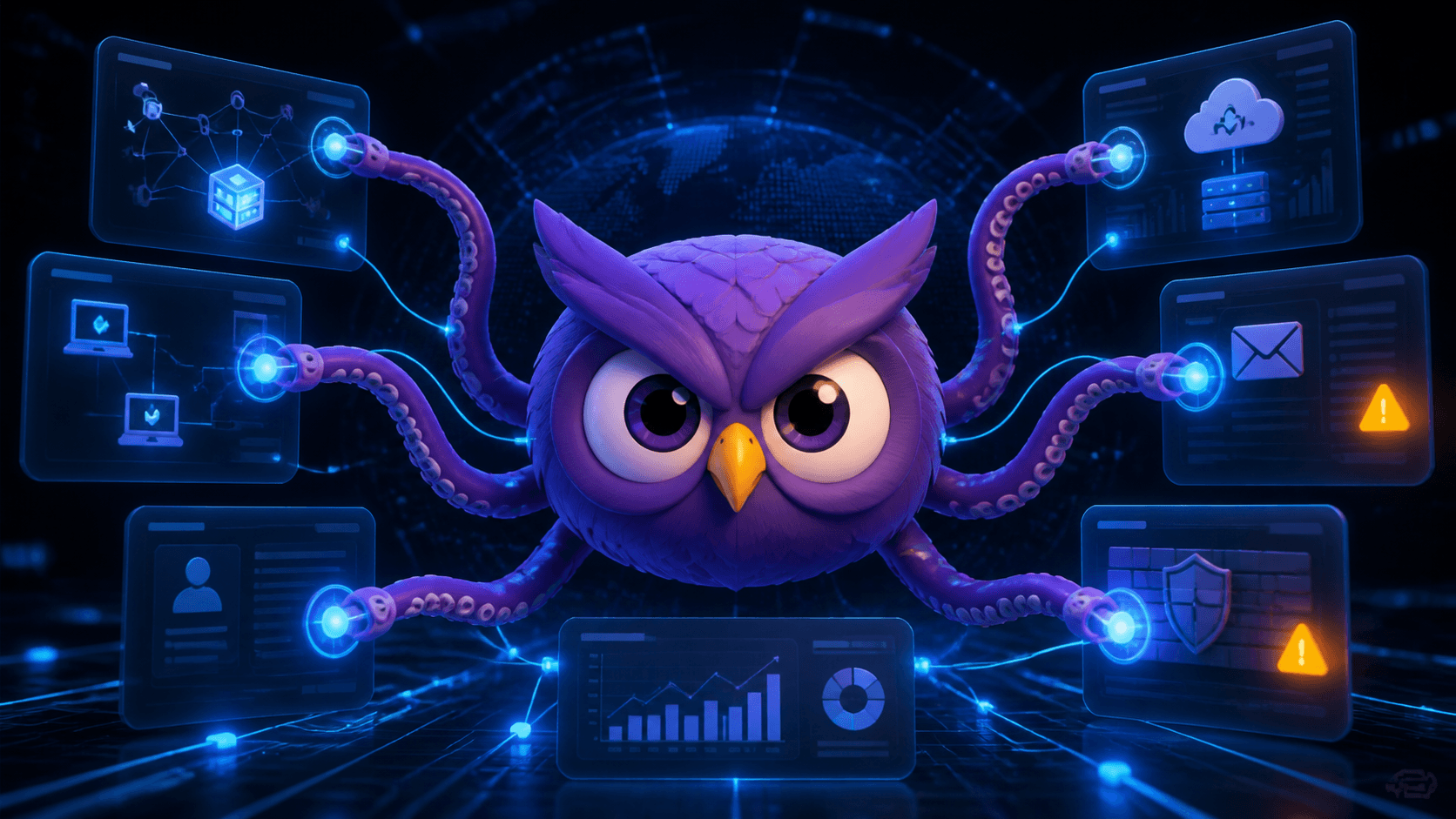
The old emergency reflex was physical: unplug the cable, isolate the machine, stop the bleeding. That still has a place in incident response, but it is no longer a sufficient strategy for AI-speed attacks. Modern intrusions move through identity, cloud APIs, SaaS tokens, CI/CD systems, package registries, model gateways, endpoint agents, and collaboration tools. By the time a human finds the right owner, opens the right console, and waits for approval, the attacker may already have changed credentials, staged data, created persistence, or moved into a cleaner path.
The next security operating model is an autonomous agentic security platform: a governed self-service layer where approved defensive agents can inspect every major security tool, correlate weak signals, recommend action, and execute pre-approved containment in seconds or microseconds when policy allows it. This is not a chatbot bolted onto a SIEM. It is a control plane for defensive action across SIEM, SOAR, EDR, XDR, CNAPP, CSPM, identity, email security, vulnerability management, asset inventory, data security, code scanning, secrets management, ticketing, and network enforcement.
The reason this matters now is capability speed. Anthropic's Fable 5 and Mythos 5 updates showed how frontier AI capability, cyber safeguards, access controls, jailbreak severity, and government concern are moving into the same conversation. Whether a company uses Anthropic, OpenAI, open models, or internal agents, the message is the same: high-capability models compress cyber timelines. They can reason across long task chains, write and test code, summarize reconnaissance, interpret error messages, and adapt. Defenders cannot answer machine-speed offense with human-only swivel-chair operations.
Crypto-funded and financially motivated attackers make the speed problem worse. Ransomware crews, token theft groups, exchange-targeting actors, and fraud operations already have strong economic incentives to automate. They do not need perfect artificial general intelligence. They need faster reconnaissance, better phishing, cheaper exploit chaining, more convincing social engineering, and automated triage of which victims are worth pursuing. Agentic AI lowers the cost of those steps. That means security teams need response architectures that assume hostile automation is already part of the threat model.
A serious autonomous security platform starts with visibility. Defensive agents need read access to the facts that matter: authentication events, privileged session history, endpoint process trees, cloud control-plane logs, repository changes, CI/CD workflow runs, package downloads, egress destinations, data access, email delivery metadata, vulnerability context, asset ownership, and current business criticality. If the agent can only see alerts after another tool has decided something is suspicious, it will miss the weak-signal chains that AI-assisted attackers are likely to create.
The second layer is policy-constrained action. Autonomous defense should not mean an unrestricted bot with admin rights. It should mean a set of explicitly approved actions tied to confidence, blast radius, asset class, and business context. A defensive agent may be allowed to revoke a single suspicious OAuth token immediately, quarantine a non-critical endpoint, disable an impossible-travel session, block a newly observed command-and-control domain, or pause a risky CI job. Higher-impact actions, such as disabling a production identity provider integration or isolating a revenue-critical cluster, should require human approval with a machine-prepared evidence packet.
Microsecond action matters most where the action is narrow and reversible. Blocking one malicious token, one outbound destination, one suspicious workload identity, one package publish, or one impossible session can stop a chain before it becomes a breach. The platform should record the detection signal, the policy that authorized action, the affected object, the rollback path, and the human owner. Speed without accountability creates operational risk. Accountability without speed creates breach risk. The platform needs both.
Self-service is the part many companies miss. Security cannot become the only team allowed to operate the agentic platform. Developers, cloud teams, identity teams, legal, privacy, fraud, and business application owners need safe ways to ask questions and request bounded actions. A product engineer should be able to ask which services depend on a vulnerable package. An identity owner should be able to ask which privileged accounts touched a risky app. A cloud lead should be able to ask which workloads can be isolated without customer impact. The security platform should answer with evidence, provenance, and recommended actions, not vague summaries.
The platform also needs adversarial controls for the agents themselves. Each agent should have its own identity, least-privilege scope, approval policy, memory boundary, tool allowlist, model route, cost budget, audit log, and emergency kill switch. Agent prompts, tool calls, retrieved documents, generated detections, and executed actions should be logged. Sensitive environments should use sandboxing and egress control. Model gateways should enforce data-loss rules, prompt-injection defenses, and per-use-case routing. The agentic platform must be secure before it becomes powerful.
The best architecture looks less like a single giant brain and more like a supervised swarm. One agent specializes in identity, one in endpoint telemetry, one in cloud posture, one in software supply chain, one in data access, one in network containment, and one in executive explanation. A coordinator agent can assemble the evidence and propose an action plan, but the system should preserve separation of duties. This reduces blast radius and makes it easier to test, monitor, and improve each agent's behavior.
For CISOs, the business case is straightforward: autonomous agentic security reduces mean time to understand, mean time to contain, and mean time to explain. It also helps with talent scarcity. A mature platform lets a small team cover more telemetry, produce better incident narratives, and respond to low-risk events without waiting for every analyst to manually copy context between tools. The goal is not replacing security professionals. The goal is giving them machine-speed leverage with enterprise-grade guardrails.
For boards, the message should be even simpler. AI is turning cyber risk into an execution-speed problem. Blocking AI tools internally does not stop attackers from using them externally. Unplugging cables does not revoke cloud tokens, stop SaaS exfiltration, rotate secrets, pause poisoned builds, or contain autonomous reconnaissance. Companies need a defensive control plane that can observe across the environment, act within policy, and prove what happened afterward.
The practical starting point is a 90-day pilot. Connect the platform to identity, endpoint, cloud, SIEM, ticketing, and code repositories in read-only mode. Define five narrow response actions that are low-blast-radius and reversible. Run the agents against historical incidents and current alerts. Measure accuracy, action latency, false positives, analyst time saved, and evidence quality. Only then expand to automated containment for well-understood patterns.
HackWednesday's view is that autonomous agentic security will become a core enterprise platform category. The winners will not be the teams that blindly automate everything. They will be the teams that give defensive agents full context, narrow authority, strong audit trails, and pre-approved playbooks. In the Fable 5 era and beyond, the question is not whether AI changes security operations. The question is whether defenders can act before the attacker finishes the next step.
Source notes
Follow these links to check the reporting and documentation behind this article.