
Top Cybersecurity Stocks to Watch in 2026: A Security-Team Watchlist, Not Financial Advice
A practical, SEO-friendly overview of public cybersecurity and security infrastructure companies that appear across major cybersecurity ETFs in 2026, written for security teams, CISOs, and market-aware builders. This is not financial advice.
Legal placeholder: this article is for general education and cybersecurity market literacy only. It is not financial advice, investment advice, legal advice, tax advice, or a recommendation to buy, sell, hold, or trade any stock, ETF, option, crypto asset, or security. Always do your own research and consult a licensed financial advisor before making investment decisions.
If you searched for top security stocks in 2026, the useful question is not simply which ticker is popular today. For CISOs, security teams, founders, and operators, the better question is: which public companies represent the control planes that enterprises are actually buying to defend identity, cloud, endpoint, network, applications, data, and AI workflows?
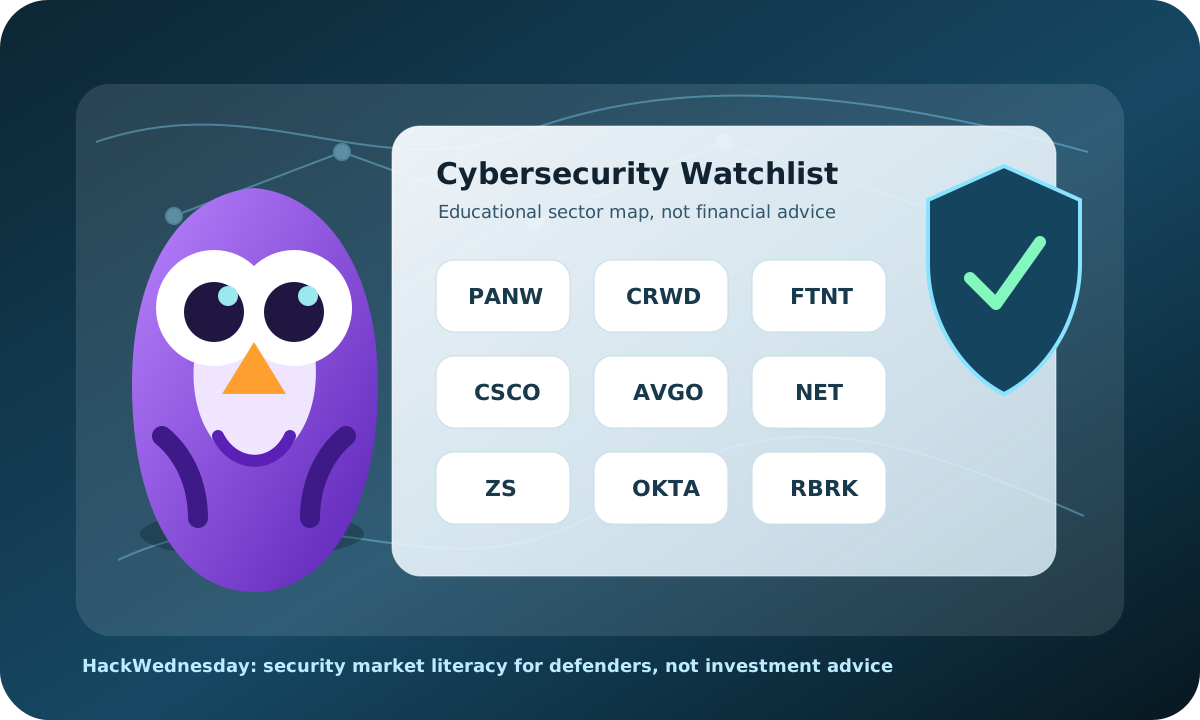
HackWednesday does not rank stocks by expected return. Instead, this watchlist looks at companies that appear prominently across cybersecurity-focused ETF holdings and that represent important security categories. ETF holdings change frequently, but they are a practical signal for which names public-market cybersecurity investors track. As of late August 2026, First Trust's CIBR, Amplify's HACK, and BlackRock's iShares IHAK all surface familiar security and security-adjacent names such as Palo Alto Networks, CrowdStrike, Fortinet, Cisco, Broadcom, Cloudflare, Zscaler, Okta, Rubrik, Qualys, SentinelOne, Tenable, and F5.
Palo Alto Networks is one of the broadest cybersecurity platform companies to understand. For security leaders, the important operational lens is not only firewall history. Palo Alto Networks sits across network security, cloud security, security operations, threat intelligence, and platform consolidation. That makes PANW a useful public-company proxy for how enterprises think about integrated security platforms and whether buyers want fewer vendors with broader control-plane coverage.
CrowdStrike represents the endpoint, identity, cloud, and threat-operations side of modern defense. Security teams watch CrowdStrike because endpoint telemetry, managed detection, identity protection, cloud workload visibility, and AI-assisted operations increasingly converge. The business question behind CRWD is whether customers keep consolidating endpoint, SOC, cloud, and exposure workflows into a data-rich platform.
Fortinet remains important because network security is not disappearing in the AI era. Secure networking, firewall refreshes, SD-WAN, OT environments, branch security, and firewall performance still matter when companies connect offices, factories, cloud workloads, and remote users. FTNT is worth understanding as a signal for security teams that still need high-performance infrastructure controls, not just SaaS dashboards.
Cisco is a security stock to watch because it sits at the intersection of networking, identity, observability, collaboration, and security. Cisco's security story includes firewalls, XDR, zero trust, identity-adjacent controls, and enterprise networking visibility. Security teams should understand Cisco because many large enterprises already run Cisco infrastructure, which means security adoption can follow existing network and enterprise relationships.
Broadcom is not a pure-play cybersecurity company, but it appears in cybersecurity ETF holdings because security infrastructure includes chips, enterprise software, and acquired security assets. Broadcom's relevance is tied to security-adjacent infrastructure, VMware, Symantec enterprise security history, and large-enterprise IT control points. For defenders, AVGO is a reminder that cyber exposure is often controlled through infrastructure platforms that are not branded only as security tools.
Cloudflare is a security infrastructure company to watch because it sits in front of internet traffic. Its relevance spans DDoS protection, web application security, Zero Trust access, bot management, API protection, network services, and edge controls. NET is especially relevant to HackWednesday's AI security audience because browser, API, bot, and agent traffic all increase the value of edge visibility and policy enforcement.
Zscaler is a core name in Zero Trust and secure access service edge. Security teams track ZS because cloud-delivered access control changes how companies replace legacy VPN patterns, inspect traffic, control SaaS usage, and route users through security policy. In an AI-heavy company, secure access and data loss controls become more important because users and agents touch more SaaS, code, files, and web systems.
Okta represents identity as a security control. OKTA matters because identity is now the control plane for humans, service accounts, SaaS apps, non-human identities, and AI agents. Whether a company uses Okta or another identity provider, the category is central to AI security because model gateways, agents, MCP servers, and automation need identity, scopes, approval, and revocation.
Rubrik is a public-company proxy for cyber resilience, backup, recovery, and data security posture. RBRK matters because breach response is no longer only about detection. Companies need clean recovery paths, immutable backups, ransomware readiness, sensitive data visibility, and tested restoration of critical services. AI-speed attacks make recovery architecture more strategic, not less.
Qualys, Tenable, and SentinelOne represent different parts of exposure management, vulnerability management, and endpoint defense. QLYS and TENB are important because enterprises need asset inventory, scanning, vulnerability prioritization, and compliance evidence. SentinelOne remains relevant because endpoint and autonomous response still sit close to the moment of attack. Security teams should evaluate these companies by control value, detection quality, platform integration, and customer trust, not just market buzz.
A practical way to evaluate cybersecurity stocks as a security professional is to map each company to the problems buyers must solve. Does the product reduce breach probability? Does it shorten mean time to detect and respond? Does it replace multiple tools? Does it create better evidence for auditors and boards? Does it protect AI agents, cloud identities, APIs, developer workflows, and sensitive data? Does it survive budget scrutiny when CISOs consolidate vendors?
The AI security angle matters. The next wave of security spending will not only be traditional endpoint, firewall, and SIEM. It will include agent identity, model gateways, MCP security, AI coding assistant governance, browser and SaaS controls, software supply chain defense, secrets management, AI data loss prevention, and automated response. Public companies that adapt existing platforms into these control planes may become more relevant to security buyers, regardless of short-term stock movement.
The risk side is equally important. Cybersecurity stocks can be volatile. Growth expectations, valuation, competition, acquisitions, platform outages, breach disclosures, product execution, government demand, macro conditions, interest rates, and customer consolidation can all move prices. A company can be operationally important to security teams and still be a poor investment at a given price. That is why this article is not a buy list.
For SEO searches like best cybersecurity stocks, top security stocks, AI security stocks, cybersecurity ETF holdings, and security companies to watch, the most honest answer is a watchlist framework. Study the companies that appear repeatedly in cybersecurity ETFs. Read their filings. Understand the product categories. Compare revenue quality, customer concentration, gross margin, free cash flow, competitive moat, breach history, platform credibility, and AI security strategy. Then separate product importance from investment decision-making.
HackWednesday's bottom line: security teams should understand public cybersecurity companies because they shape vendor roadmaps, acquisition strategy, platform consolidation, hiring markets, and board conversations. But understanding the sector is different from making a trade. Treat this as a cybersecurity market map, not a portfolio recommendation. The legal placeholder still stands: this is not financial advice.
Source notes
Follow these links to check the reporting and documentation behind this article.