
Quantum and Photonics After Math: What Security Teams Should Prepare For
Quantum computing changes the cryptographic risk model, while photonics changes how data moves through chips, data centers, clocks, sensors, and future AI systems. Security teams should prepare for both without treating either as magic.
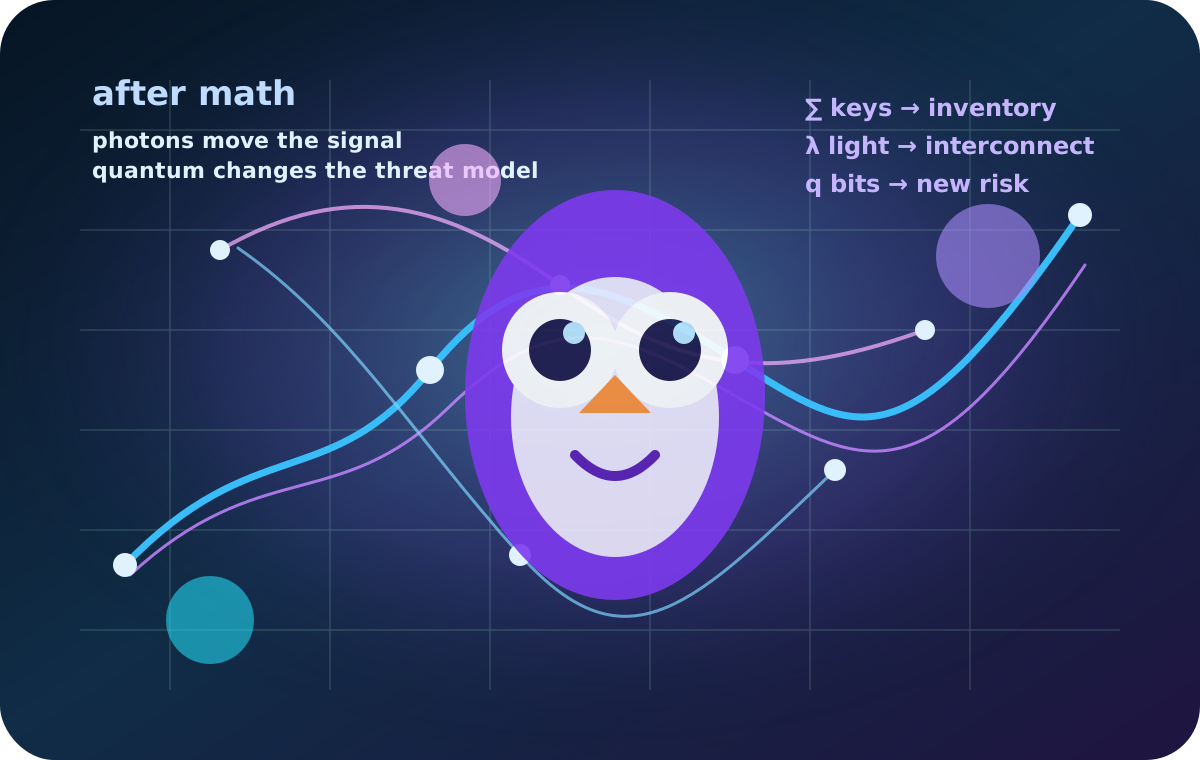
Quantum and photonics are easy to overhype because both sound like science fiction. Quantum computing promises machines that use quantum states instead of ordinary bits for certain classes of problems. Photonics uses photons, or light, to move, shape, generate, and sometimes process information. Together they point toward a post-classical computing era where security teams need to think beyond today’s assumptions about math, chips, interconnects, clocks, sensors, and cryptography.
The phrase 'after math' is useful as a warning. Security does not move into a world without mathematics. It moves into a world where some of the math we depend on today becomes fragile. Most internet security still leans heavily on public-key cryptography for key exchange, signatures, software updates, identity, code signing, TLS, VPNs, device trust, cloud control planes, and payment systems. A cryptographically relevant quantum computer could threaten widely used public-key schemes. That is why post-quantum cryptography is not an academic side quest. It is infrastructure planning.
NIST has already moved this from theory into standards work. Its post-quantum cryptography project released principal federal standards in 2024: FIPS 203 for ML-KEM key establishment, FIPS 204 for ML-DSA signatures, and FIPS 205 for SLH-DSA signatures. NIST also says organizations should begin applying these standards and identifying where vulnerable algorithms are used. The operational message is simple: quantum risk has a long deployment tail, so migration needs to start before the emergency arrives.
For CISOs, the first quantum question is not 'when will quantum break everything?' The better question is 'where do we use vulnerable cryptography, and how long must that data stay confidential?' A customer password reset link that expires in 15 minutes has a different risk profile than medical data, design files, classified records, signing keys, identity roots, legal archives, or encrypted traffic that an adversary can store now and decrypt later. The phrase 'harvest now, decrypt later' matters because long-lived secrets can be at risk before large-scale quantum computers are available.
Photonics enters from a different door. Photonic systems use light for communication and control. In data centers, photonics can help move signals faster and more efficiently between chips, boards, racks, and facilities. In quantum systems, photonics can help generate, route, and control the precise light needed for qubits, clocks, sensing, and communication. NIST’s 2026 integrated photonics work describes chips that process photons with lasers, waveguides, filters, and switches, with potential impact across AI infrastructure, quantum computers, optical atomic clocks, communications, navigation, and biomedical systems.
That makes photonics less like a replacement for every CPU and more like a new nervous system for computing. Electronics will continue to handle many forms of logic, memory, control, and general-purpose computing. Photonics is more likely to dominate where light is naturally superior: high-bandwidth movement of data, low-latency interconnects, precise timing, sensing, optical networking, and some specialized acceleration. The near future is probably hybrid: electrons for many decisions, photons for fast movement and specialized physical operations.
Security teams should care because new physical layers create new trust boundaries. If photonic interconnects become central to AI clusters and quantum systems, defenders will need asset inventory, supply-chain assurance, side-channel analysis, tamper detection, optical component provenance, firmware review, control-plane logs, and incident playbooks for hardware that does not look like a traditional server. A light-based path is still a path. It can still fail, drift, leak metadata, be misconfigured, be counterfeited, or become part of a supply-chain dependency.
Quantum and photonics also meet in timing and sensing. Optical atomic clocks, quantum sensors, and photonic components can improve navigation, measurement, synchronization, and scientific instrumentation. That is powerful, but security teams should expect operational consequences: more precise systems can create more precise dependencies. If a future factory, satellite link, financial platform, military system, or AI data center depends on timing and optical control loops, then resilience, monitoring, fallback modes, and tamper evidence become security requirements, not physics trivia.
The cybersecurity preparation path has three tracks. First, build a cryptographic inventory. Know where RSA, Diffie-Hellman, elliptic-curve cryptography, signatures, certificates, SSH keys, S/MIME, VPNs, TLS libraries, device firmware signing, package signing, and long-lived encrypted archives exist. Second, plan post-quantum migration. Watch vendor roadmaps, test hybrid key exchange where available, update procurement language, and prioritize systems with long-lived confidentiality or root-of-trust impact. Third, track photonic and quantum dependencies in architecture reviews, especially for AI infrastructure, high-performance computing, telecom, edge, aerospace, critical infrastructure, and hardware supply chains.
The biggest mistake is waiting for a single announcement that says quantum is now real. Security migration does not work that way. It took years to remove weak hashes, old TLS versions, hardcoded keys, and legacy identity assumptions, and many organizations still carry them. Post-quantum migration will be harder because it touches protocols, libraries, hardware modules, certificates, vendors, embedded systems, backups, archives, and compliance evidence.
The second mistake is thinking photonics is only a performance topic. Performance changes architecture. Architecture changes security. When the bottleneck moves from compute to interconnect, from electronic signaling to optical routing, or from ordinary clocks to optical timing systems, the location of risk moves too. Security teams that understand the physical and logical architecture early will write better procurement requirements and better incident playbooks.
The HackWednesday recommendation is pragmatic. Do not panic about quantum. Do not dismiss photonics. Start with inventory, data lifetime, cryptographic agility, vendor dependencies, and architecture diagrams. Ask every critical vendor how they plan to support post-quantum cryptography. Ask AI infrastructure vendors how photonic interconnects, optical components, and timing systems are monitored and secured. Ask internal platform teams whether certificates, keys, firmware signatures, and encrypted archives can be migrated without heroic manual work.
Quantum may change which math protects trust. Photonics may change how fast and efficiently trust moves through infrastructure. The future of computing is unlikely to be purely quantum or purely photonic. It will be hybrid, layered, specialized, and messy. That is exactly why security teams should prepare now: not because the future is magic, but because the transition will be operationally ordinary, slow, expensive, and full of hidden dependencies.
Source notes
Follow these links to check the reporting and documentation behind this article.
- NIST: Post-Quantum Cryptography project
- NIST: PQC standards overview
- CISA, NSA, and NIST: Migrating to Post-Quantum Cryptography
- NIST: Integrated photonics chips for light circuits
- NIST: Photonic chip transforms a single beam into multiple beams
- HackWednesday: Post-Quantum Cryptography Checklist for Security Teams