
NSA and FBI Warn on QTFY: What Security Teams Should Do About Chinese Hacker Covert Networks
The NSA, FBI, and Cyber National Mission Force warned that China-linked QTFY actors used QScan, QTRouter, compromised IoT devices, and covert proxy infrastructure to target military, government, telecommunications, higher education, and critical infrastructure networks. The defender lesson is clear: patch fast, reduce exposed operational data, isolate critical systems, and hunt with evidence.
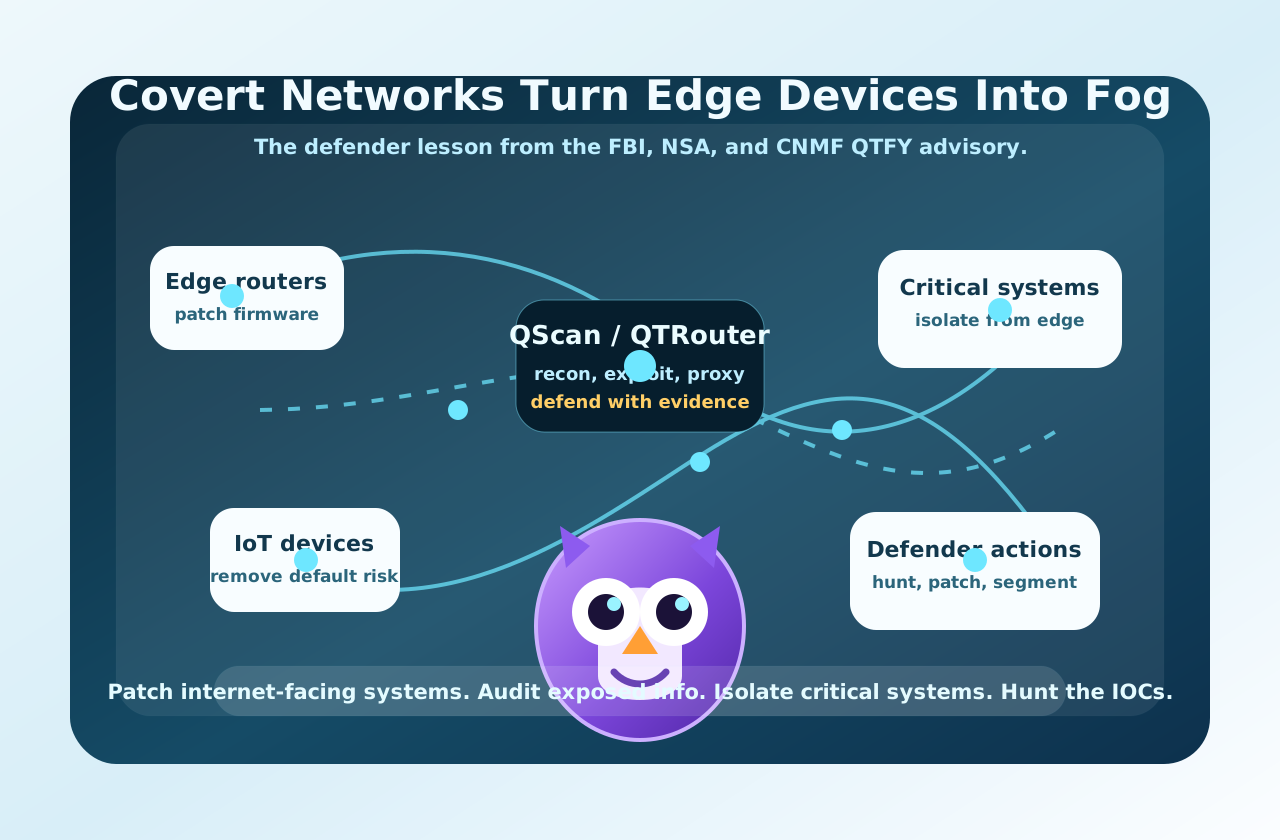
The August 26, 2026 joint advisory from the FBI, NSA, and Cyber National Mission Force is a useful Hack Wednesday case study because it shows how modern intrusion campaigns hide in the ordinary internet. The advisory focuses on China-linked actors using the acronyms QTFY, QT, and QTCYBER, and describes malicious distributed systems used to compromise U.S. and foreign organizations.
The core warning is not just that a named actor exists. The warning is that covert infrastructure has become a repeatable operating model. QTFY activity allegedly combined vulnerability scanning, exploit tooling, compromised IoT devices, commercial proxy services, leased infrastructure, and obfuscation networks so malicious traffic could blend with legitimate users and make attribution harder.
The advisory names two complementary platforms: QScan and QTRouter. At a high level, QScan is described as a vulnerability scanning and exploitation platform used for reconnaissance and targeting. QTRouter is described as an obfuscation network built from compromised devices, proxy services, and other infrastructure. Together, they let operators find vulnerable systems and route activity through a fog of normal-looking internet traffic.
The Department of Justice and FBI also announced court-authorized domain seizures tied to QScan and QTRouter. DOJ said the domains were used for essential communication and authentication tasks, and that seizure made the platforms inoperable. That matters because disruption is now part of defense: not only blocking malware, but breaking the infrastructure that makes campaigns scalable.
The targeting list should get attention from boards and security leaders. The NSA press release says QTFY-linked products enabled targeting across defense industrial base, communications, government, and higher education. The DOJ release named U.S. government and critical entities among targets, including NASA, the Federal Reserve, Department of Energy, Department of Justice, Department of Health and Human Services, National Institutes of Health, and the U.S. Senate.
For defenders, the important pattern is the use of edge and internet-facing systems. The joint advisory's key actions are direct: apply the latest software and firmware updates, audit webpages and internet-facing applications to reduce unintended operational information disclosure, isolate critical systems from edge devices, and hunt for the provided indicators of compromise.
Those four actions sound basic, but they map to the actual attack path. If routers, VPNs, firewalls, appliances, CMS plugins, or exposed management interfaces stay vulnerable, attackers get the first foothold. If public pages, portals, docs, certificate metadata, and app responses expose too much operational context, attackers get targeting intelligence. If critical systems trust edge devices too much, compromise travels inward. If defenders do not hunt, covert networks remain quiet.
This is why patching cannot be a quarterly ritual. The advisory describes targeting across years and references both zero-day and N-day exploitation. N-day risk is especially painful because it means a fix exists, but the exposed system remains reachable long enough for attackers to operationalize public knowledge. For internet-facing infrastructure, speed is a control.
Security teams should separate patching into two lanes. The first lane is normal enterprise patch management: test, stage, deploy, and measure coverage. The second lane is exposed-infrastructure emergency handling: internet-facing VPNs, firewalls, routers, remote access systems, identity edges, file transfer systems, and management appliances. Those systems need owner mapping, maintenance windows, compensating controls, and executive support before the next advisory arrives.
The QTFY story also shows why asset inventory is still the unglamorous foundation. You cannot patch what you cannot find. You cannot isolate what nobody owns. You cannot hunt across logs you do not collect. Every critical infrastructure organization should know which devices are internet-facing, which versions they run, which services they expose, which business systems they can reach, and which teams own them.
The covert network angle should change detection strategy. If malicious traffic comes through compromised routers, IoT devices, commercial proxies, and local-looking infrastructure, simple country blocking will miss the point. Defenders need behavior-based detections: unusual authentication paths, new administrative access, impossible service relationships, abnormal outbound connections, suspicious scanning patterns, unusual user agents, and activity against edge systems outside normal maintenance windows.
Network segmentation is the control that turns an edge compromise from an enterprise incident into a contained event. The advisory's recommendation to isolate critical systems from edge devices should be treated literally. Internet-facing infrastructure should not have broad implicit access to identity systems, production databases, OT networks, build systems, backups, or executive data stores.
For SOC teams, this incident class should become a standing hunt package. Hunt for advisory IOCs, but do not stop there. Build repeatable queries for edge-device authentication, firmware changes, unexpected admin interfaces, outbound proxy behavior, DNS anomalies, webshell-like patterns, new scheduled tasks on adjacent systems, and lateral movement from network appliances or remote access infrastructure.
For vulnerability teams, this is a prioritization lesson. CVSS alone is not enough. Prioritize by exposure, exploitability, actor interest, device role, reachable downstream systems, available telemetry, and business criticality. A medium or high vulnerability on an internet-facing edge device may deserve more urgency than a nominally critical flaw buried behind strong segmentation.
For executives, the message is that critical infrastructure risk is not only a technical backlog. It is operational readiness. Security teams need budget and authority to replace unsupported devices, patch during emergency windows, remove unmanaged IoT, centralize logs, isolate critical systems, and run tabletop exercises where the first compromised device is a router, firewall, VPN appliance, or camera.
For AI security teams, there is also a second-order lesson. Large-scale scanning, exploit selection, target enrichment, and infrastructure management are exactly the workflows that automation can accelerate. Defenders should expect faster reconnaissance and more targeted exploitation as attackers combine conventional tooling with AI-assisted analysis. The answer is not panic. The answer is faster asset intelligence, faster patch decisions, and tighter segmentation.
A practical thirty-day response plan starts with exposed assets. Export every internet-facing asset from cloud, DNS, EASM, CNAPP, firewall, VPN, CDN, and certificate inventory. Match each asset to an owner. Verify firmware and software versions. Close unknown management ports. Remove stale systems. Confirm that critical systems are not reachable from the edge except through intentional, logged, least-privilege paths.
The next thirty days should focus on evidence. Confirm logging from edge devices, identity providers, remote access systems, DNS, proxy, EDR, cloud control planes, and critical internal services. Build detections for unusual access from edge infrastructure. Load the advisory IOCs into the SIEM where appropriate. Create an incident playbook for compromised network infrastructure, including isolation, credential rotation, firmware validation, forensic capture, and replacement decisions.
The final step is to rehearse. A QTFY-style tabletop should ask simple questions: Which edge device was compromised? What did it know? What could it reach? Which credentials touched it? Which logs prove the timeline? Which critical systems were isolated? Which patch window failed? Which business owner can authorize emergency downtime? Which customer-facing services stay running if the edge layer is distrusted?
The HackWednesday takeaway is clear: covert networks reward organizations that leave edge systems exposed, unpatched, overtrusted, and underlogged. The defensive answer is not one magic product. It is disciplined exposure management, emergency patch lanes, segmentation, IOC hunting, behavioral detections, and incident rehearsals focused on the devices everyone forgets until attackers use them.
Source notes
Follow these links to check the reporting and documentation behind this article.
- NSA: NSA joins FBI in issuing warning about Chinese hacking group QTFY cyber activity
- Joint CSA: China-Linked Hacking Group QTFY Targets Military and Critical Infrastructure with Malicious Distributed Systems
- DOJ: Justice Department and FBI seize platforms operated and used by China state-sponsored hackers
- NSA: Defending against China-nexus covert networks of compromised devices
- NSA: PRC actor living off the land targeting U.S. critical infrastructure
- CISA: Secure by Design