
Defending Humans Against Future mRNA, DNA, and Bio-Cyber Attacks
A practical, non-alarmist guide to future bio-cybersecurity: protecting genomic data, synthetic nucleic acid supply chains, clinical systems, and people from misuse while preserving responsible medicine.
In this article (6 sections)
Important framing first: this article is not medical advice, and it is not claiming that normal mRNA vaccines are DNA attacks. CDC explains that COVID-19 vaccines do not affect or interact with human DNA, and that mRNA vaccine material does not enter the cell nucleus where DNA is kept. The real future risk is different: cyber, biosecurity, supply-chain, identity, and misinformation failures around increasingly powerful biological platforms.
mRNA and DNA technologies are becoming normal parts of medicine, diagnostics, therapeutics, vaccine development, cancer research, and synthetic biology. That progress is valuable. The defense question is how humans, healthcare systems, labs, and governments keep trust as the tools become cheaper, more automated, more data-driven, and more connected to AI.
A practical bio-cybersecurity program starts by separating science from panic. mRNA is an instruction molecule. DNA is long-term genetic information. Gene therapy, as FDA describes it, can modify or manipulate genes to treat or cure disease under regulated clinical pathways. Synthetic nucleic acid technologies can also be misused if sequence design, ordering, manufacturing, lab access, or clinical delivery are poorly governed. Those are different risk classes and should not be collapsed into one scary phrase.
The core question for the next decade is simple: who can design, order, manufacture, analyze, modify, store, approve, and deliver biological instructions, and how do we know the answer is still true?
What would a future mRNA or DNA attack actually mean?
A useful threat model avoids movie logic. The most realistic defensive categories are not secret instant DNA rewriting. They are compromise of trust paths around biological work.
The first category is genomic data abuse. NIST IR 8432 explains that genomic data has unique cybersecurity and privacy concerns because it can reveal sensitive details about identity, kinship, traits, and health status. Unlike a password, a genome cannot simply be rotated after a breach. Human defense therefore includes strong consent, encryption, access control, monitoring, deletion policies, and strict limits on secondary use.
The second category is synthetic nucleic acid misuse. NIST's synthetic nucleic acid biosecurity work focuses on sequence screening, risk mitigation, standards, databases, and ways to identify emerging sequences of concern. ASPR's screening guidance FAQ describes why order screening and customer legitimacy checks matter for synthetic nucleic acid providers and benchtop synthesis manufacturers. The goal is not to block legitimate research. The goal is to make dangerous or suspicious orders harder to place unnoticed.
The third category is clinical supply-chain compromise. A future attacker may target scheduling systems, ordering workflows, batch records, cold-chain monitoring, lab information systems, identity providers, cloud storage, or vendor portals. In that scenario, the cyber path can damage patient trust even if no biology is successfully altered. Healthcare cybersecurity is patient safety.
The fourth category is unauthorized gene-therapy or do-it-yourself medical manipulation. FDA-regulated gene therapy has safety and effectiveness review pathways. Humans should treat unverified online protocols, unlicensed treatments, and anonymous biological products as high-risk. The practical defense is boring and strong: licensed clinicians, regulated products, informed consent, traceable manufacturing, and adverse-event monitoring.
The fifth category is misinformation. A hostile campaign does not need to modify biology if it can convince people to reject safe care, buy fake treatments, publish private genetic data, or harass legitimate researchers. Future biosecurity has to defend institutions and people against narrative manipulation, not only lab incidents.
How individuals can defend themselves
Individuals do not need to become molecular biologists to reduce personal risk. They need better verification habits. Use licensed healthcare professionals for medical decisions. Be skeptical of any product or influencer promising genetic enhancement, immune rewriting, unregulated mRNA treatment, or private gene therapy outside legitimate clinical oversight.
Protect genetic and health data more like permanent identity data than ordinary account data. Before using consumer genetic or health platforms, read the privacy policy, data-sharing policy, deletion process, law-enforcement disclosure language, and third-party research options. Use strong unique passwords, passkeys or multi-factor authentication when available, and avoid reusing health account passwords anywhere else.
For medical content, prefer sources that separate evidence from certainty. A strong source says what is known, what is unknown, who reviewed it, and what data supports it. A weak source relies on urgency, secret knowledge, absolute claims, or pressure to bypass clinicians.
If a person believes they may have received an unsafe medical product, they should contact a qualified healthcare provider or appropriate public health authority. Do not try to self-diagnose a biological exposure from social media instructions.
How healthcare and biotech organizations should defend people
For organizations, the strongest defense is to treat bio-cyber risk as one system. Genomic data, clinical platforms, lab instruments, sequencing pipelines, manufacturing systems, cloud workflows, and supplier portals should not be managed as isolated islands.
Start with a data map. Identify where genomic data, sequence files, batch records, clinical trial data, patient identifiers, lab results, and synthetic nucleic acid orders are created, transformed, stored, shared, and deleted. NIST's genomic data work points to lifecycle risk: generation, processing, sharing, monitoring, and policy gaps all matter.
Then reduce identity risk. Give lab systems, cloud services, AI tools, sequencing pipelines, and automation jobs distinct identities. Remove shared accounts. Use least privilege, short-lived credentials, approval gates for sensitive actions, and logs that connect every action to a person, service, device, dataset, and business purpose.
Segment lab and clinical environments. A ransomware incident should not be able to jump from an office workstation to sequencing instruments, manufacturing records, patient care systems, and cold-chain monitoring without resistance. Keep offline recovery plans and test restoration for systems that affect patient safety.
Protect the software supply chain. Bioinformatics workflows often use open-source packages, notebooks, containers, cloud storage, and workflow managers. Treat them like production software: pin dependencies, scan containers, review code, protect secrets, require signed or verified artifacts where feasible, and monitor for unusual data movement.
For synthetic nucleic acid procurement, use providers and equipment workflows that support sequence screening, customer verification, transfer records, and responsible review. ASPR's guidance emphasizes legitimacy checks and recordkeeping for sequences of concern. That is a governance control, not just a procurement detail.
For AI-assisted life-science workflows, keep the model away from unchecked authority. AI can help classify literature, summarize safety documentation, compare policies, and support defensive screening. It should not be allowed to silently approve sensitive biological orders, bypass biosafety review, or route confidential genomic data to uncontrolled providers.
The human-first control stack
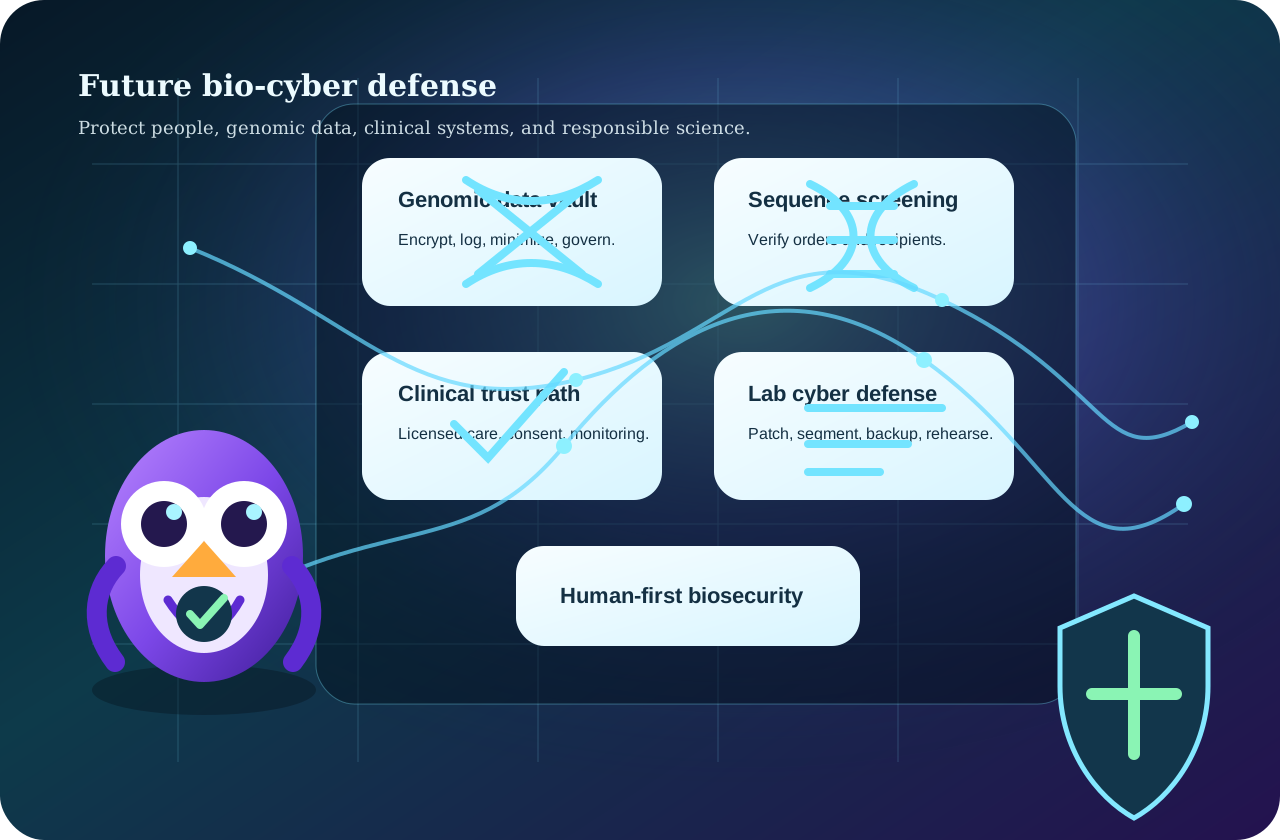
A future-ready human defense stack has seven layers. First, scientific literacy: people should understand that approved mRNA vaccines are not DNA rewriting, while also recognizing that biological systems deserve serious governance. Second, identity: every human, machine, service, lab device, and AI workflow needs accountable access. Third, data protection: genomic and clinical data require encryption, minimization, retention limits, and auditable sharing.
Fourth, procurement screening: synthetic nucleic acid orders, benchtop synthesis equipment, and material transfers need legitimacy checks and sequence-of-concern screening. Fifth, clinical verification: treatments should be licensed, traceable, consented, monitored, and delivered by qualified providers. Sixth, cyber resilience: healthcare and biotech organizations need patching, backups, segmentation, incident exercises, and ransomware readiness. Seventh, trust response: misinformation, fraud, and panic require rapid, transparent communication from credible institutions.
This stack is intentionally multi-disciplinary. A CISO cannot solve it alone. Neither can a biosafety officer, physician, researcher, vendor, or regulator. WHO's responsible life-sciences framework describes biorisk mitigation and dual-use governance as a shared responsibility across policy makers, scientists, institutions, funders, publishers, security actors, and the private sector.
What security teams should do before this becomes urgent
Run a tabletop exercise that combines cyber and bio operations. Scenario: a lab vendor account is compromised, a suspicious sequence-order workflow appears, a ransomware group claims access to genomic data, and social media begins spreading false medical claims. Ask who owns decisions, what logs exist, which systems can be isolated, which data was exposed, and how clinical operations continue safely.
Create a genomic-data incident checklist. Include privacy counsel, clinical leadership, security operations, lab operations, vendor contacts, public communications, and patient notification triggers. Standard breach response language may not be enough because genomic data has family, ancestry, health, and permanence implications.
Review AI usage in biotech and healthcare workflows. Which teams are sending genomic, clinical, sequence, or research data into AI systems? Which providers are approved? Are logs retained? Are prompts and outputs treated as records? Are models allowed to call tools, submit orders, or change data? If the answer is unknown, the organization has a bio-cyber blind spot.
Use healthcare cybersecurity baselines. HHS 405(d) and HICP focus on strengthening the healthcare and public health sector against cyber threats. CISA's ransomware guidance reinforces asset inventory, least privilege, vulnerability management, backups, incident response, and restoration planning. Those controls sound general because they are foundational; they also apply when the data is biological.
Frequently asked questions
Can mRNA vaccines change human DNA? CDC says COVID-19 vaccines do not affect or interact with DNA, and mRNA vaccine material does not enter the cell nucleus where DNA is kept. This article is about future bio-cybersecurity risks around biological systems, not a claim that approved mRNA vaccines are DNA attacks.
What is bio-cybersecurity? Bio-cybersecurity is the protection of biological data, lab systems, bioinformatics pipelines, manufacturing workflows, clinical platforms, and life-science supply chains from cyber, privacy, safety, and misuse risks.
What is the biggest personal risk from DNA-related attacks? For most people, the realistic near-term risks are privacy exposure, identity linkage, misinformation, unregulated products, health account compromise, and misuse of genetic or health data. Protect health accounts and be cautious about where permanent genetic data is stored and shared.
How can organizations reduce future mRNA and DNA misuse risk? Organizations should map genomic and clinical data, segment lab systems, enforce strong identity, protect supply chains, screen synthetic nucleic acid procurement, use approved AI workflows, rehearse incident response, and communicate clearly during misinformation events.
The right posture is neither panic nor complacency. mRNA, DNA, gene therapy, and synthetic biology can improve human health. They also create trust paths that attackers may target. Defending humans in the future means protecting the science, the data, the systems, the supply chain, and the public conversation at the same time.
Source notes
Follow these links to check the reporting and documentation behind this article.
- CDC: COVID-19 Vaccine Basics
- FDA: What is Gene Therapy?
- NIST IR 8432: Cybersecurity of Genomic Data
- NIST: Biosecurity for Synthetic Nucleic Acid Sequences
- ASPR: Synthetic Nucleic Acid Screening FAQ
- WHO: Responsible Use of the Life Sciences
- HHS 405(d): Health Industry Cybersecurity Practices
- CISA: StopRansomware Guide