
Vercel Breach Claims: What Security Teams Should Do About Environment Variables, Tokens, and Deployment Trust
Vercel confirmed unauthorized access to certain internal systems while hackers claimed to be selling stolen data. Security teams should avoid panic, but immediately review activity logs, rotate exposed environment variables, harden sensitive variables, and check GitHub, npm, and deployment tokens.
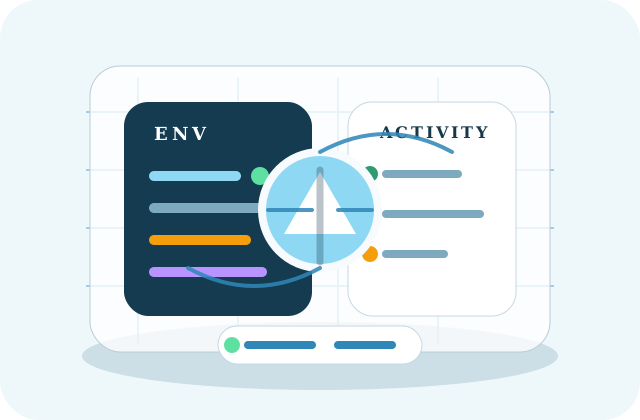
Vercel published a security bulletin on April 19, 2026 confirming unauthorized access to certain internal Vercel systems. The company said it is actively investigating, has engaged incident response experts, notified law enforcement, and identified a limited subset of impacted customers that it is contacting directly. Vercel also said its services remain operational. That official confirmation matters because it separates the known incident from the broader claims circulating around stolen data.
The BleepingComputer report that triggered wider attention said hackers claimed to be selling stolen Vercel data. Those claims should be treated carefully: attacker statements are not the same as verified impact, and extortion groups often exaggerate scope to create pressure. But defenders should not wait for perfect attribution before doing practical work. When a deployment platform reports unauthorized access to internal systems, the right response is controlled urgency: identify what could be exposed, rotate what matters, and preserve evidence.
The highest-priority area is environment variables. Vercel's own bulletin recommends that customers review activity logs, review and rotate environment variables, and use the sensitive environment variable feature. That is the right starting point because deployment platforms often hold API keys, database URLs, webhook secrets, OAuth credentials, analytics tokens, storage credentials, and third-party service keys. If those values are readable by users or integrations with project access, a platform incident can quickly become a downstream credential incident.
Teams should begin by listing every Vercel project that handles production traffic or sensitive customer workflows. For each project, review production and preview environment variables, identify anything that grants write access or data access, and rotate credentials in a safe order. Update Vercel with the new credential before invalidating the old one, then redeploy so the new value is actually used. Remember that changing environment variables does not automatically update old deployments; you need fresh deployments for applications to pick up the new values.
Sensitive environment variables deserve special attention. Vercel documents sensitive variables as non-readable once created, designed for values such as API keys. Existing variables must be removed and re-added with the sensitive option enabled if a team wants that protection. Security teams should use this incident as a forcing function to classify variables: public configuration, low-risk operational settings, secrets that must be sensitive, and secrets that should not live in the platform at all because they belong in a dedicated secret manager or short-lived identity flow.
The second response lane is activity review. Vercel's Activity Log records events across a team, including project and environment-variable activity. Review account membership changes, environment variable reads or updates, deployment changes, domain changes, integration changes, and suspicious actions around the incident window. If your team uses shared environment variables, check those events too. The goal is not to prove compromise from one log line; it is to establish whether any action deviated from normal release and administration behavior.
The third response lane is connected identity. Vercel projects often connect to GitHub, GitLab, Bitbucket, npm packages, webhooks, analytics platforms, CMS systems, payment providers, databases, and cloud accounts. If a Vercel incident touches project configuration or environment variables, teams should review Git provider access, GitHub app permissions, npm publish tokens, deploy hooks, build hooks, API tokens, and cloud credentials. Rotate anything that can deploy code, publish packages, read customer data, or modify infrastructure.
This is also a good moment to reduce blast radius. Move from long-lived static secrets toward short-lived credentials and OIDC where possible. Restrict production deployment permissions. Separate preview and production credentials. Avoid sharing broad team-level environment variables with every project. Enforce least privilege for project members. And require sensitive variables for production and preview secrets wherever the platform supports that policy.
Communication should stay factual. If your organization uses Vercel and has customers asking questions, avoid repeating unverified criminal claims as fact. A better message is: Vercel has confirmed unauthorized access to certain internal systems; the investigation is ongoing; we are reviewing logs, rotating credentials where appropriate, and checking connected systems; we will update customers if we identify impact. That posture is calm, evidence-based, and more credible than either panic or silence.
The bigger lesson is that deployment trust is now a security tier of its own. Modern platforms are not just hosting websites. They sit between source code, CI/CD, secrets, preview environments, production rollouts, analytics, and AI-generated application workflows. Whether the final Vercel impact proves narrow or broad, security teams should treat this incident as a tabletop exercise: if your deployment platform had unauthorized access tomorrow, could you identify all secrets, rotate them safely, verify Git and cloud integrations, and explain your customer impact within hours?
Source notes
Follow these links to check the reporting and documentation behind this article.