
OpenAI and Trivy: How Security Teams Can Turn Vulnerability Scans into Actionable AI Triage
Trivy is excellent at finding known vulnerabilities, misconfigurations, secrets, and SBOM risk. OpenAI-style agentic security workflows can help teams turn that scanner output into prioritized, reviewable remediation without treating AI as the source of truth.
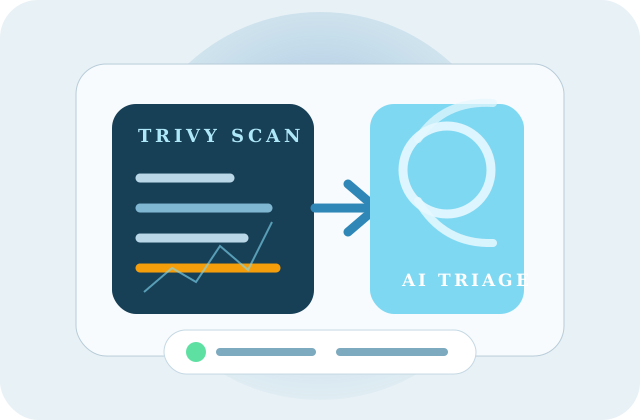
Trivy and OpenAI belong in the same security conversation because they solve different parts of the same operational problem. Trivy is a unified security scanner for vulnerabilities, file systems, Git repositories, container images, configuration issues, hard-coded secrets, Kubernetes resources, and SBOM inputs. OpenAI's Codex Security research preview is framed around identifying, validating, and remediating vulnerabilities with codebase-specific context. Put together carefully, the pattern is powerful: use Trivy for fast, repeatable evidence collection, then use AI to help humans understand, prioritize, and fix what matters.
The key is to avoid pretending that an LLM is a vulnerability database. Trivy already knows how to inspect container images, filesystems, repositories, Kubernetes assets, SBOMs, and IaC configurations. It can report known CVEs, misconfiguration findings, exposed secrets, and license or SBOM signals depending on the target and scanner configuration. That deterministic output should remain the factual starting point. The AI layer should not invent findings. It should explain the scan result, connect it to the affected service, propose a remediation plan, and draft a pull request or ticket that a human can review.
A healthy OpenAI plus Trivy workflow starts in CI/CD. Run Trivy with machine-readable output on container images, application repositories, IaC directories, and SBOMs. Keep the raw JSON or SARIF artifact attached to the build. Then pass a reduced, sanitized summary into an OpenAI workflow: package name, vulnerability ID, severity, fixed version if available, affected image or repository path, ownership metadata, and deployment context. The model can then cluster related issues, flag likely internet-facing exposure, and draft a remediation order that aligns with business risk rather than simply sorting by CVSS.
Codex Security-style workflows become especially useful when the scanner finding needs code context. A Trivy result can tell a team that a vulnerable dependency exists. It may not know whether the vulnerable function is reachable in the application, whether the package is only used in a test fixture, or whether upgrading it will break a sensitive code path. An agentic review process can inspect the repository, build a threat model, validate whether a finding is realistic, and propose a patch with tests. That is where AI can reduce triage fatigue without weakening engineering judgment.
The security boundary matters. Teams should avoid sending secrets, customer data, proprietary scan artifacts, or complete build logs into any AI workflow without a clear data governance decision. Redact tokens. Strip environment variables. Keep sensitive reproduction steps in controlled systems. Prefer enterprise-approved OpenAI configurations where legal, retention, and access controls have been reviewed. And require source-linked reasoning: if an AI assistant says a vulnerability is exploitable or low risk, it should point to the Trivy finding, the affected code path, and the specific assumption behind the judgment.
A practical prompt pattern is simple: give the AI the Trivy finding summary, the application context, and the constraints. Ask it to return a short risk explanation, the safest remediation path, test suggestions, and a pull request description. For example, a team might ask it to prioritize HIGH and CRITICAL Trivy findings for production-facing services, propose version bumps only when a fixed version exists, and mark anything involving authentication, deserialization, template rendering, or network parsing for manual AppSec review. This keeps the model inside a narrow job rather than letting it wander into speculative security theater.
This pairing also helps security leaders. Trivy output can be noisy across large fleets, especially when old base images, transitive packages, and IaC drift pile up. OpenAI-assisted summarization can translate that backlog into a smaller operational brief: what changed this week, what is newly exploitable, what is blocked by platform ownership, and what needs an exception with an expiry date. The result is not a magical scanner. It is a better conversation between AppSec, platform engineering, and service owners.
The best mental model is evidence first, reasoning second, review always. Let Trivy gather the facts. Let OpenAI help compress context, draft remediation, and challenge prioritization. Keep humans in the approval loop for production-impacting changes. If teams follow that order, OpenAI and Trivy can become a practical vulnerability operations pair: scanner precision plus AI-assisted security judgment, without giving up control of the remediation pipeline.
Source notes
Follow these links to check the reporting and documentation behind this article.