
Companies Need to Get Ready for Anthropic Mythos: What Project Glasswing Means for AI Security Readiness
Anthropic's Claude Mythos Preview and Project Glasswing are a warning shot for enterprise security teams: AI-driven vulnerability discovery is moving toward machine speed, and companies need secure sandboxes, patch pipelines, and executive governance before attackers copy the playbook.
Anthropic's Claude Mythos Preview has moved from leak-driven speculation into a more concrete enterprise security signal. On April 7, 2026, Anthropic announced Project Glasswing, an initiative that gives a controlled group of major technology and infrastructure organizations access to Mythos Preview for defensive cybersecurity work. The important lesson for companies is not whether every claim about the model is independently proven yet. It is that frontier AI is now being openly positioned as a force multiplier for finding, reproducing, and patching vulnerabilities at a speed most security programs are not built to absorb.
That creates a readiness problem. If models like Mythos can help trusted defenders discover weaknesses faster, similar classes of capability will eventually become available to less careful actors, weaker labs, criminal groups, or open replications. Anthropic's framing is defensive-first, and Project Glasswing includes major partners such as AWS, Apple, Cisco, CrowdStrike, Google, JPMorganChase, the Linux Foundation, Microsoft, NVIDIA, and Palo Alto Networks. But the broader market signal is clear: vulnerability discovery, exploit development, and remediation assistance are all moving into an AI-accelerated phase.
Companies should start by assuming that their patch latency is now a competitive security metric. If a model can find critical weaknesses in complex codebases, the old habit of letting remediation queues sit for weeks or months becomes much more dangerous. Security leaders need to know which applications matter most, which systems expose customers to the greatest risk, and which owners can ship fixes quickly. The security program should be measured not only on detection, but on how quickly it can move from validated finding to safe deployment.
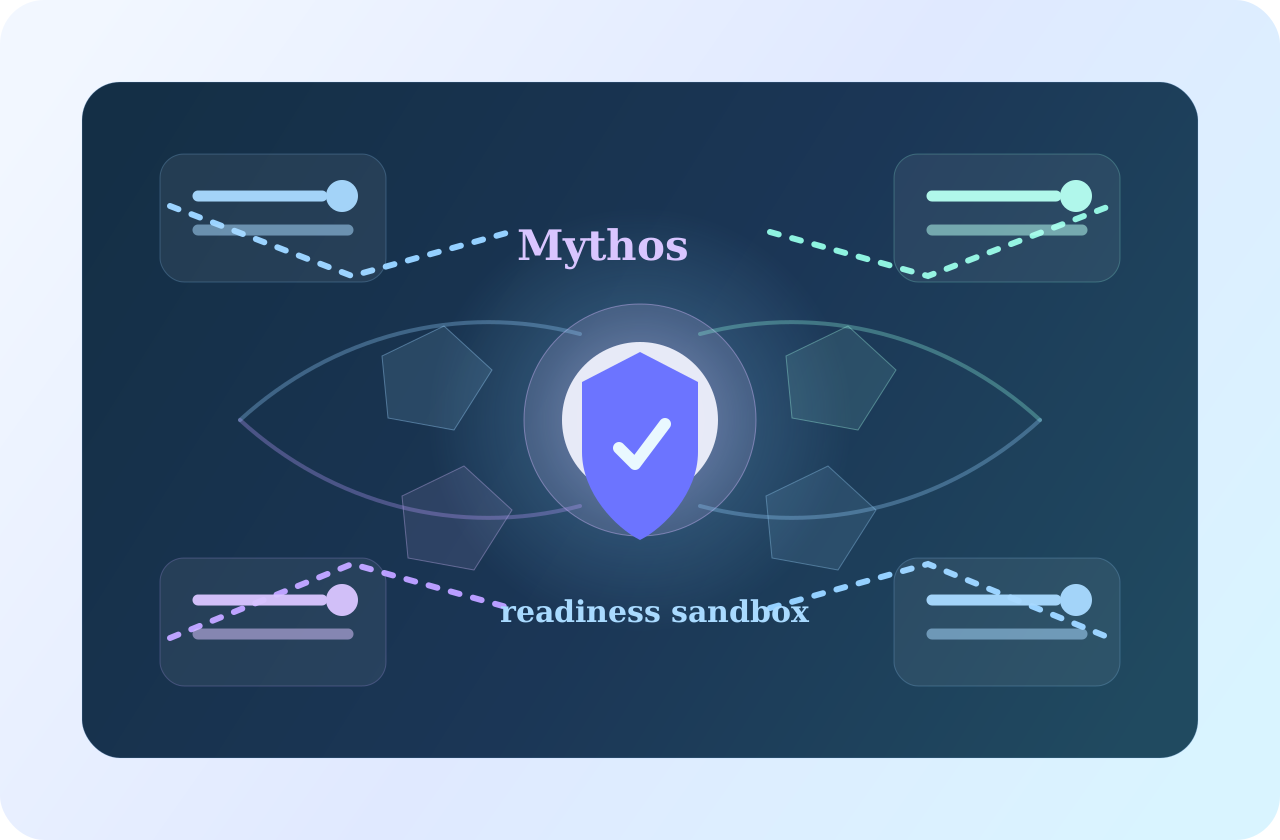
The second move is to create a secure sandbox for AI security work. Teams should not drop powerful models or agentic tools directly into production code, cloud consoles, ticket queues, or customer data. A better pattern is to create isolated analysis environments with copied code, synthetic or masked data, tightly scoped credentials, restricted network egress, and full logging. The goal is to let AI help with triage, exploit reasoning, reproduction, and patch drafts while keeping the model away from high-impact write paths until a human and automated policy checks approve the next step.
Third, companies need an AI vulnerability operations process. That means defining how model-generated findings are validated, deduplicated, prioritized, assigned, and re-tested. A model saying 'critical' is not enough. The workflow should require reproducible evidence, affected version ranges, exploitability notes, compensating controls, and a clear owner. The best teams will combine AI-assisted analysis with SAST, DAST, SBOMs, runtime telemetry, dependency intelligence, and manual review so that Mythos-class output becomes part of an evidence pipeline rather than a flood of untrusted alerts.
Fourth, the executive team needs a policy for controlled adoption. Blocking every frontier model may feel safe, but it can leave defenders slower than attackers. Blind adoption is worse. The middle path is governed access: approved tools, approved sandboxes, red-team testing, data-handling rules, prompt and output logging, and role-based permissions. Companies should also have a clear answer for shadow AI, because employees experimenting with agentic tools near sensitive systems can create exactly the uncontrolled side doors that attackers will target.
Finally, leaders should keep some skepticism. Fortune first reported Mythos through an accidental Anthropic content leak in March, Axios amplified concerns about AI-enabled cyberattacks, and The Guardian later highlighted skepticism that some claims could be safety-driven marketing as much as measured technical disclosure. That skepticism is healthy. But it should not become paralysis. Even if the most dramatic Mythos claims prove overstated, the direction of travel is still obvious: AI will compress the time between vulnerability discovery, exploit creation, and remediation pressure.
The practical conclusion is that every company should treat Project Glasswing as a tabletop exercise prompt. If a Mythos-class model found 500 severe issues in your environment tomorrow, could your team validate them? Could you sandbox the work? Could you patch the top customer-impacting systems first? Could you prevent the model from touching secrets, production systems, or sensitive customer data? The companies that answer those questions now will be better positioned when AI-speed vulnerability discovery stops being a preview and becomes the normal operating environment.
Source notes
Follow these links to check the reporting and documentation behind this article.