
CleverHans Lab's Adaptive AI Worm Moves the Risk Beyond Prompt Injection
University of Toronto researchers at CleverHans Lab demonstrated a prototype AI-driven computer worm that can map, test, and compromise heterogeneous enterprise networks in an isolated lab. The important shift is that this class operates outside AI apps and attacks ordinary IT infrastructure.
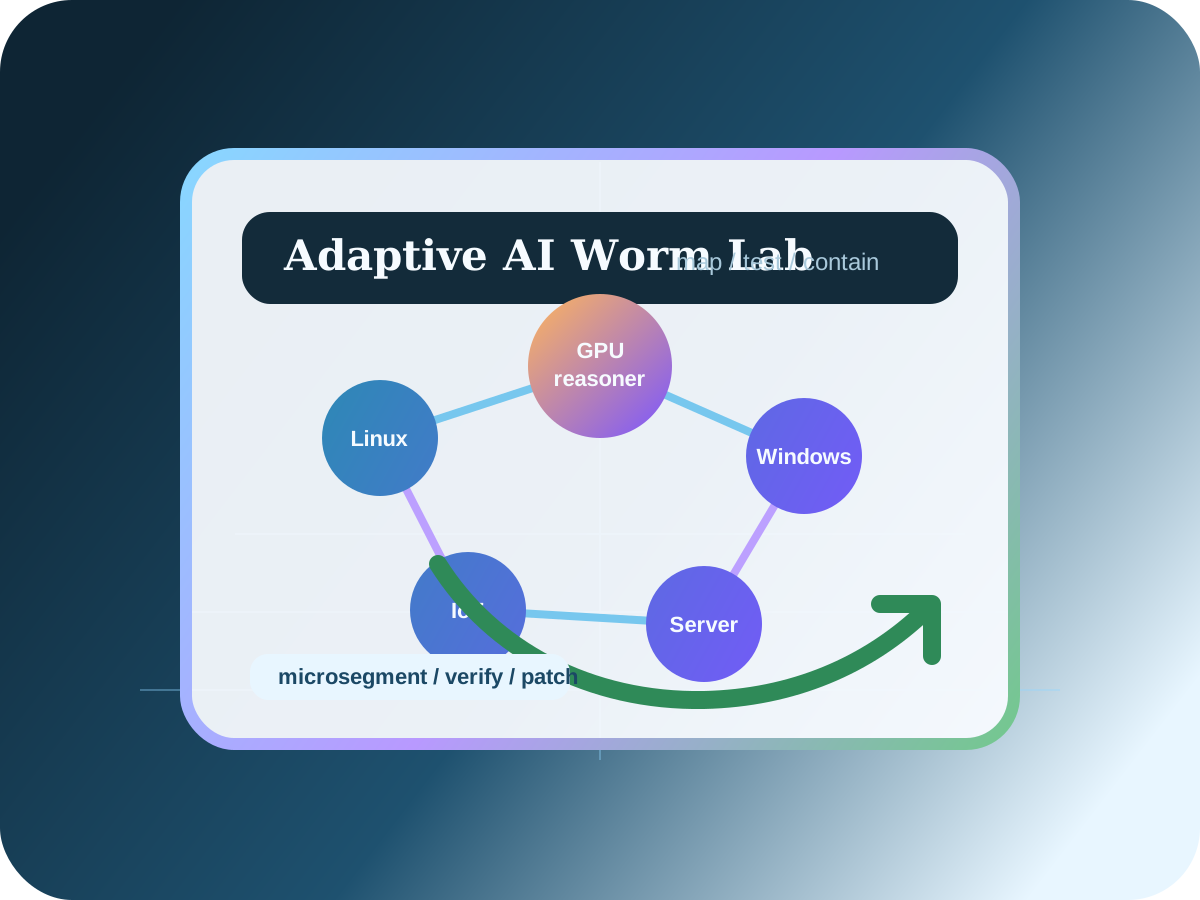
CleverHans Lab at the University of Toronto has published one of the more important AI security research signals of 2026: a prototype AI-driven computer worm that can autonomously reason across a network, identify target-specific weaknesses, compromise machines, and copy itself onward. The work, titled "AI Agents Enable Adaptive Computer Worms," was conducted by researchers from the University of Toronto, Vector Institute, University of Cambridge, and ServiceNow. The prototype was tested only inside an isolated virtual network, and the researchers say they are not publicly releasing the implementation.
The major breakthrough is not that someone attached an LLM to offensive tooling. It is that the worm replaces a fixed exploit path with a reasoning loop. Traditional worms often spread by exploiting one vulnerability at scale. WannaCry, for example, had a narrow path: if the target was vulnerable to the exploited SMB weakness, the worm could move; if not, that path failed. CleverHans Lab's prototype changes the model. It can inspect each target, reason about that machine's unique configuration, select from known vulnerabilities or misconfigurations, and adapt its strategy as it moves.
That makes this meaningfully different from earlier AI worm research such as Morris II. Morris II was a prompt-injection worm for generative AI ecosystems, especially RAG-backed AI email assistants. It showed that a malicious self-replicating prompt could spread through AI applications and cause data leakage or unwanted actions inside those AI-mediated workflows. The CleverHans Lab work is broader and more uncomfortable: it does not depend on compromising an AI email assistant or propagating through model context. It uses a local open-weight model as part of the attack infrastructure, then attacks the underlying enterprise environment: Linux hosts, Windows systems, IoT devices, reused credentials, and recently disclosed vulnerabilities.
The researchers also make an important economic point. Their prototype used an open-weight model running locally on modest hardware rather than a commercial frontier model. That means cloud AI safety controls such as refusals, rate limits, and centralized content filters are not the main defense. If an attacker controls the local model runtime, vendor-side moderation does not sit in the path. The prototype also demonstrates a tiered design where compromised GPU-capable nodes can provide reasoning support to lighter agents running on other machines. In effect, the worm can parasitically acquire compute from the environment it is attacking.
The lab's technical notes are deliberately limited, which is the right disclosure posture for this class of dual-use research. They say the prototype did not include standard malware evasion capabilities, did not try to hide itself, and was never deployed outside the contained environment. They also describe observable behaviors from the proof of concept: beacon callbacks on non-standard ports, automated SSH public key injection, and systematic credential reuse across hosts. Those are not universal signatures for all future adaptive worms, but they are useful defender anchors because they show where the research prototype left operational traces.
For security teams, the uncomfortable lesson is that patching one vulnerability is no longer the whole containment story. CleverHans Lab says the prototype did not require novel zero-day discovery; it relied on public vulnerabilities, newly disclosed issues, misconfigurations, and recurring weakness classes. That is exactly what real attackers already use. The difference is orchestration. A model-driven worm can keep trying, pivoting, and composing steps against each host rather than failing when one exploit path does not match. That raises the value of exposure management, asset context, credential hygiene, and segmentation because the worm's advantage comes from finding the path defenders forgot.
The most immediate defensive response is to reduce the number of reachable paths. Microsegmentation, zero-trust access controls, host firewalls, and restricted east-west movement matter more when an attacker can adapt target by target. A flat corporate network is the best-case environment for this kind of system. The researchers explicitly note that their test environment represented a worst-case flat network and that even basic segmentation would substantially limit reach. That aligns with old security fundamentals, but the urgency changes when adaptation can be automated.
The second response is to compress patch and verification timelines. The prototype could incorporate newly published vulnerabilities within hours of disclosure, according to the research page. That does not mean every organization needs reckless auto-patching. It means defenders need better patch intelligence, canary testing, automated CVE verification, and clear service ownership so critical fixes do not spend weeks waiting for manual interpretation. AI-assisted defensive tooling should be aimed at the same bottleneck: finding exposed instances, validating whether a system is reachable and vulnerable, drafting fixes, and proving the patch actually closed the path.
The third response is detection engineering for autonomous behavior. Look for unusual reconnaissance sequences, repeated authentication attempts across heterogeneous hosts, automated key injection, abnormal callbacks, tool-use patterns from unexpected endpoints, and sudden use of local GPU resources by unknown processes. The exact indicators will change, but the behavior class is visible: machines start acting like operators. That should move detection away from single signatures and toward sequences that combine discovery, credential testing, privilege changes, remote execution, and replication.
This research should not be read as proof that corporate networks are already being overrun by AI worms. CleverHans Lab says this was a contained prototype, not an in-the-wild deployment. The correct takeaway is sharper: the capability line has moved. Small, local models can be connected to tools and memory in ways that produce adaptive network offense. Defenders should respond by making their environments less navigable, less reusable, and less dependent on slow manual patch interpretation. HackWednesday's short version: Morris II warned us that AI apps can carry worms; CleverHans Lab warns us that ordinary infrastructure can become the next substrate.
Source notes
Follow these links to check the reporting and documentation behind this article.
- CleverHans Lab: AI Agents Enable Adaptive Computer Worms
- arXiv: AI Agents Enable Adaptive Computer Worms
- arXiv: Here Comes The AI Worm: Unleashing Zero-click Worms that Target GenAI-Powered Applications
- IBM: Researchers develop malicious AI worm targeting generative AI systems
- MITRE ATLAS case study: Morris II Worm