
AI Attack Speed Will Outrun Slow Security Programs: Why Teams Should Embrace Secure Sandboxing, Claude-Style Agents, and RSA-Era Runtime Controls
The next wave of AI attacks will compress recon, phishing, code abuse, and privilege escalation into much faster cycles. Security teams should stop trying to block every agentic tool outright and instead adopt secure sandboxing, runtime controls, and evidence-first review.
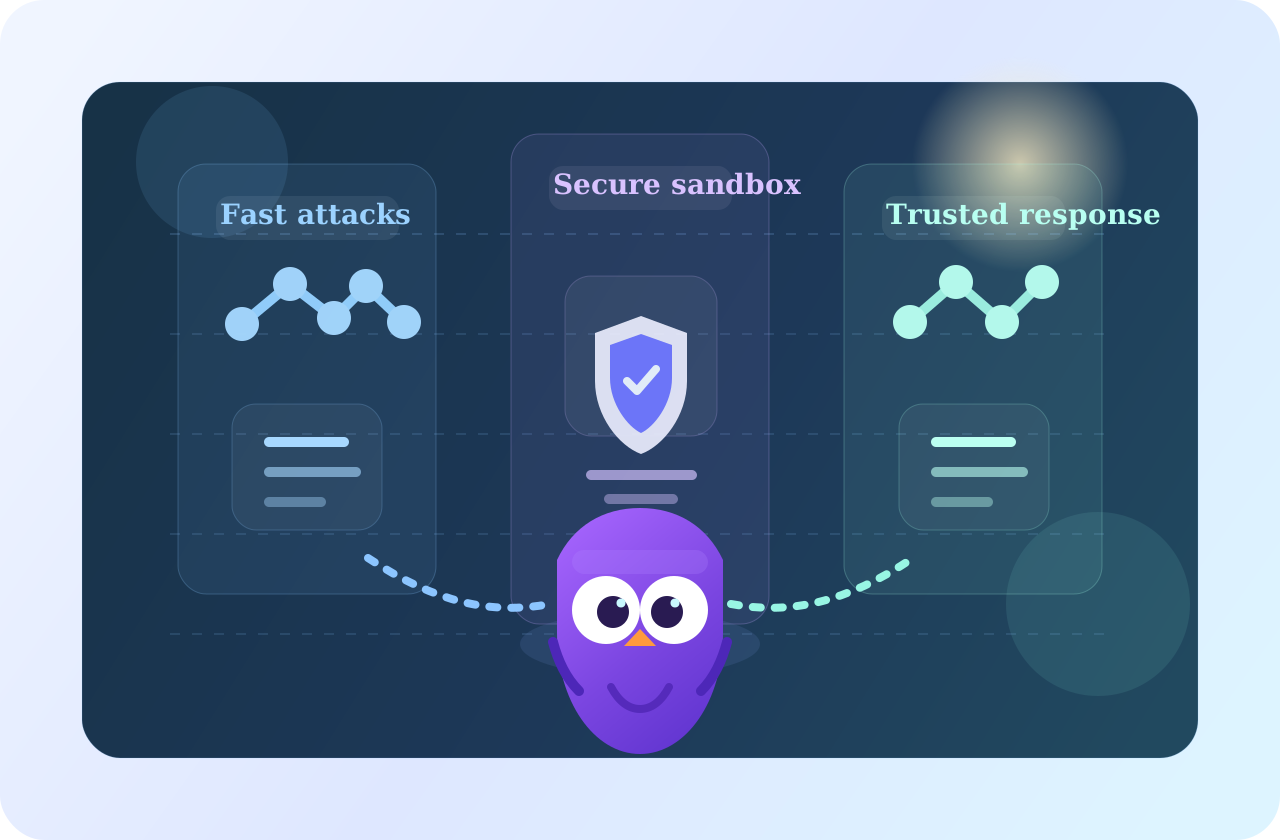
Security teams should assume that the speed of AI-assisted attacks will soon feel less like a gradual trend and more like a sharp operating shock. Attackers do not need perfect autonomous agents to create that change. They only need faster iteration across reconnaissance, phishing personalization, malware refactoring, exploit adaptation, and post-compromise scripting. The defenders that still rely on slow handoffs, overloaded review queues, and blanket tool bans are likely to discover that the new gap is not just sophistication. It is tempo.
That is why the defensive conversation needs to change. Many organizations still react to new agentic systems, Claude-style coding tools, or open frameworks by trying to block them first and think later. That instinct is understandable, especially when teams worry about data leakage, prompt injection, uncontrolled code execution, or model-generated mistakes. But a pure deny strategy does not scale. If defenders refuse to use the same classes of acceleration that attackers are already testing, they risk preserving process purity while losing operational speed.
A better approach is controlled adoption. Instead of treating AI systems as trusted operators, teams should treat them like high-speed junior analysts inside secure sandboxing boundaries. That means read-heavy defaults, ephemeral credentials, approval checkpoints for high-impact actions, egress controls, strict logging, content provenance, and isolated execution environments. The goal is not to hand the keys to an agent. The goal is to let AI compress low-trust work such as code summarization, triage preparation, artifact labeling, draft remediation, and threat-hypothesis generation without giving it silent authority over production systems.
This is where the current cultural resistance can become a strategic mistake. Tools that security teams may want to slow down today, including Claude-style coding agents or emerging open agent stacks, can also become the basis for safer defensive workflows when they are wrapped in hardened runtime controls. A secure sandbox is not a concession to risky technology. It is the mechanism that makes experimentation safe. Teams can let models inspect code in a sealed environment, propose detections against copied telemetry, simulate exploit chains without production reach, and draft infrastructure changes that must still pass human review and policy gates.
The architecture matters more than the brand name. Whether the workflow uses Claude, another frontier model, or an open agent framework, the same defensive best practices apply. Keep secrets short-lived. Separate retrieval from action. Restrict filesystem and network scope. Require source-linked outputs for factual claims. Compare model-generated changes against tests, linters, and security policy checks. Use canary environments for autonomous experiments. Log every step so incident responders can reconstruct what the agent saw, suggested, changed, or attempted. The companies that win will not be the ones that trust AI most. They will be the ones that design the best cages, controls, and review loops around it.
This theme has become more visible in the broader AI security conversation, including the RSA-adjacent discussion around runtime control, model governance, and agent oversight. That is not because conferences suddenly discovered AI risk. It is because enterprises are moving from abstract pilots to operational deployment. Once AI starts touching codebases, cloud configurations, tickets, customer data, and detection logic, the security model has to mature. The near future attack surface will favor organizations that can move fast without collapsing their trust boundaries.
The practical playbook is straightforward. Build secure sandboxes before broad rollout. Start with low-blast-radius use cases. Measure quality and drift. Keep humans accountable for production-impacting actions. Use AI to cut latency in defensive work, not to bypass governance. And resist the temptation to confuse delay with safety. The companies most prepared for AI attacks will be the ones that learn how to leverage these systems safely now, while the stakes are still manageable, instead of waiting until adversaries have already normalized machine-speed tradecraft.
Source notes
Follow these links to check the reporting and documentation behind this article.